


R&D FIELD APPLICATION ENGINEER
Diodes, which pass electric current in only one direction and are composed of semi-conducting materials, are often used in electronic circuits. In addition, diodes, which are also active circuit elements, have become one of the preferred circuit elements in many applications due to their wide variety and different areas of use. According to its structure, it consists of two ends as “anode” and “cathode”. The electrical current flows from the anode end of the diode to the cathode end. To talk about the structure, characteristics and types of the diode;
Diode Structure
Diodes are produced by combining two different semiconductor materials as “P” and “N” types. In order to obtain P- and N-type semiconductor materials, semiconductor materials such as silicon or germanium are subjected to some specific processes. In this way, positively charged holes in P-type substances, and negatively charged electrons are available in larger numbers in N-type substances. If positive voltage is applied to the anode end and a negative voltage is applied to the cathode end this is called “correct polarization”, and the positive charges contained in the P-type semiconductor move towards the negative charges of the n-type semiconductor. In this way, it is possible to transfer electric current through the diode. If a negative voltage is applied to the anode end and a positive voltage is applied to the cathode end this is called “reverse polarization”, and since there can be no charge movement, the electrical current does not pass through the diode.
Diode Characteristics
Examining the diode characteristics by looking at the following current-voltage graph: In the correct polarization (forward polarization) field, in order the current can pass through the diode, the applied voltage must be greater than 0.7 volts for the silicon diode and greater than 0.3 volts for the germanium diode. For instance, the product with the code M7_R2_00001 in Ozdisan Elektronik inventory is a silicon diode and its threshold voltage is 0.7 volts. In the reverse polarization field, no current passes through the diode until the reverse voltage applied to the diode reaches the maximum Vbr voltage. When the applied reverse voltage exceeds the Vbr voltage, the diode passes current in the opposite direction, since it will be at the breaking point. For instance, the Vbr voltage for the product with code 1N4007_AY_10001 in Ozdisan Elektronik inventory is 50 volts.
Types of Diodes
1-Crystal Diode
It is the oldest and most widely used type of diode. Since diodes started to be produced with crystal, the name has remained as “crystal diode”. It is generally used for rectifier purposes. In addition, it is also used for protection purposes at the feed input. The product range can be accessed via Ozdisan Electronics web page, under general purpose diodes section.
2-Bridge Diode
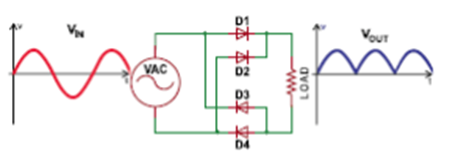
It is a type of diode produced by connecting four crystal diodes. It is used for full-wave rectifying process. Its two legs are connected to alternating current. The other two legs are the + and – legs and provide direct current transmission to the circuit. The product range can be accessed via Ozdisan Electronics web page, under bridge diodes section.
3-Zener Diode
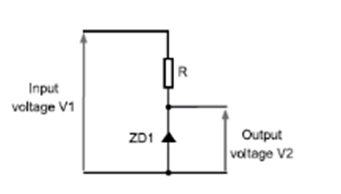
Zener diodes are usually used for voltage regulation purposes. They are connected to the circuit in such a way that they are reverse polarized. They vary according to voltage values. Ozdisan Electronics web page offers several Zener diodes between 1.5V and 300V, under zener diodes section.

4- Schottky Diode
These junction-type diodes are produced as a result of the fusion of metal and semiconductor crystal. Their threshold voltages are very low. They can quickly switch to transmission even at 0.25 volts. Their reverse direction currents are very low. In this way, they have the ability to work more efficiently. Due to their speed, they are often preferred in SMPS (switch mode power supply) circuits. The product range can be accessed via Ozdisan Electronics web page, under Schottky diodes section.
5-TVS Diyot
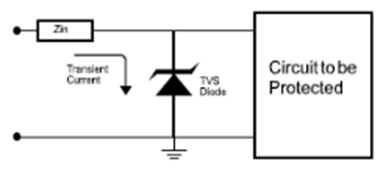
TVS (Transient Voltage Suppression) diodes are a type of diode that are widely used in electronic circuits. They protect the circuit against instantaneous voltage increases. There are two types as “bipolar” and “unipolar”. The product range can be accessed via Ozdisan Electronics web page, under TVS diodes section.
After talking about the types of diodes at the basic level, now let’s give an example of application circuits. In this way, you will have the opportunity to put the subject matters we are talking about theoretically into practice.
Using a crystal diode, the AC signal is passed through a half-wave rectification process and the signals in negative alternanses are trimmed.
Using a bridge diode, the AC signal is passed through a full-wave rectification process and the signals in negative alternanses are converted into positive alternanses signals.
When the input voltage is higher than the Zener diode voltage, the output voltage will not be higher than the Zener diode voltage. In this way, the output voltage will be regulated even if the input voltage changes. Output voltage varies according to the current flowing through the Zener diode. The minimum, nominal and maximum voltage values are specified in the datasheets based on the current flowing through the Zener diode. Below are the datasheet values for the ZMM55 series 2.4 volt Zener diode.
ZMM55-C2V4 SERIES
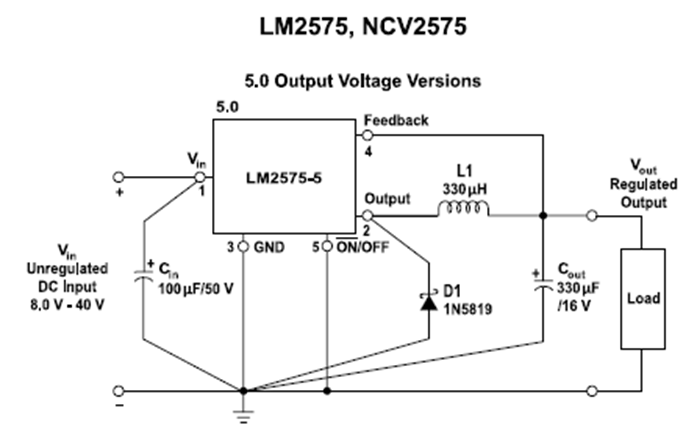
In the circuit shown above, the product (step down voltage regulator)with LM2575SX-5.0 /NOPB code in Ozdisan Elektronik inventory is used and, as the integrated output is fast and the losses are much less 1N5819_AY_10001 coded Schottky diode is preferred.
As can be seen, the TVS diode is connected parallel to the input. The TVS diode selected according to the input voltage protects the circuit against instantaneous voltage spikes. The TVS diode prevents damage to the circuit elements by passing the current over itself, in case the voltage rise is not instantaneous.
“Diodes are produced by combining two different semiconductor materials as “P” and “N” types.”
Silicon Carbide Technology
In the light of developing technology, we had the opportunity to use silicon carbide, which causes much less losses when switching at high frequencies, is resistant to high temperatures, and has high flexibility and thermal conductivity. The most important feature of this material (SiC) is that it can work at very high temperatures. It can work at temperatures 3-4 times higher than silicon. In addition, with its high thermal resistance, it allows heat to be transmitted better. Ozdisan Elektronik offers Panjit, Cree, Fuji, IXYS Schottky diodes with silicon carbide technology.
