


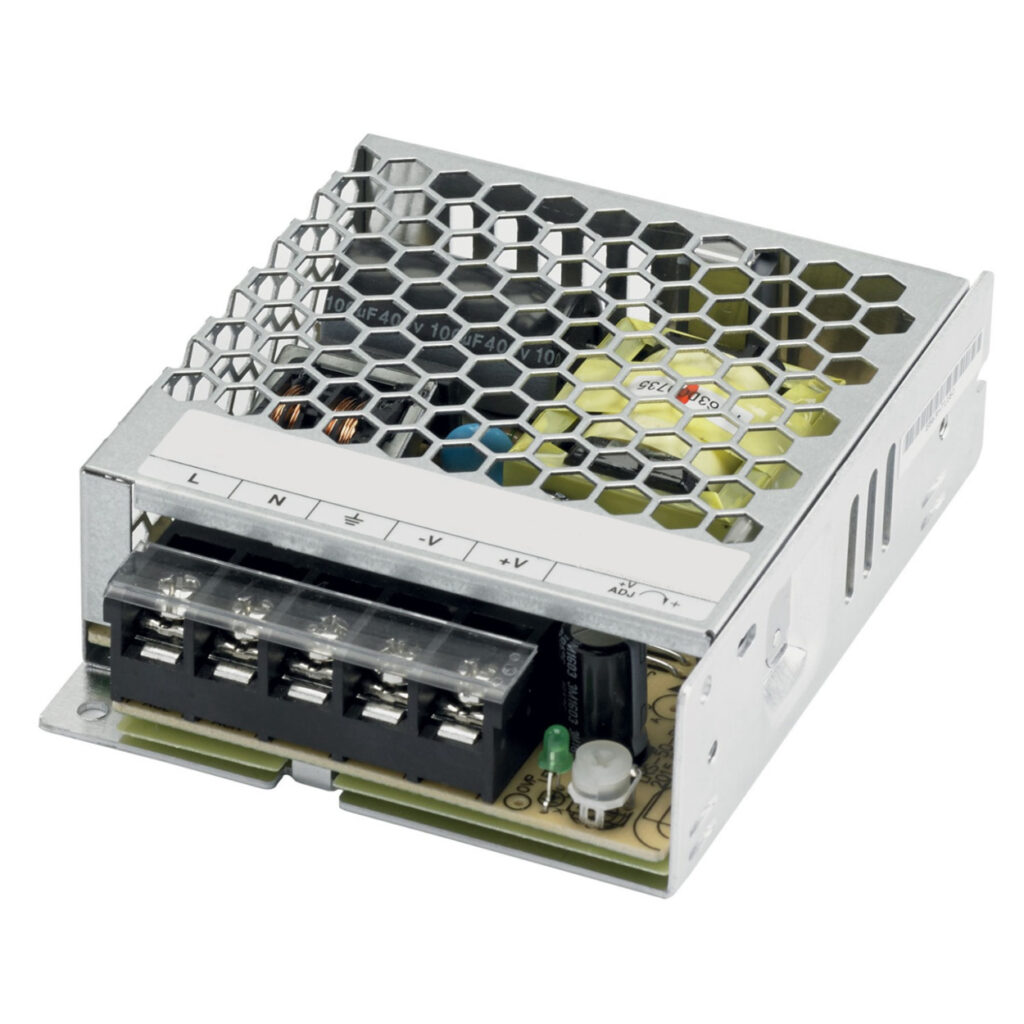

Switched-Mode Power Supply (SMPS) is an electronic power supply that incorporates a switching regulator to convert electrical power efficiently. Like other power supplies, SMPS transfers power from a DC or AC source to DC loads while converting voltage and current.
The Working Principle of SMPS Circuits
A switching regulator is integrated into the electronic power supply, which is called a Switched-Mode Power Supply (SMPS). This power supply is also referred to as a “switcher”, a ‘switched power supply’ or a ‘switching mode power supply’. This power supply effectively converts electrical power. SMPS, like other power sources, converts current and voltage characteristics when transferring energy from an AC or DC source to DC loads (like a personal computer). Switched energy sources can be significantly lighter and more compact compared to linear power sources, as their transformers can be significantly smaller. This is due to the fact that it operates at a high switching speed, ranging from several kHz to several MHz, in contrast to the 50-60Hz network frequency. The power supply architecture and the requirement for EMI (electromagnetic interference) suppression in commercial systems often leads to a significantly higher number of components and associated circuit complexity, despite a smaller transformer.
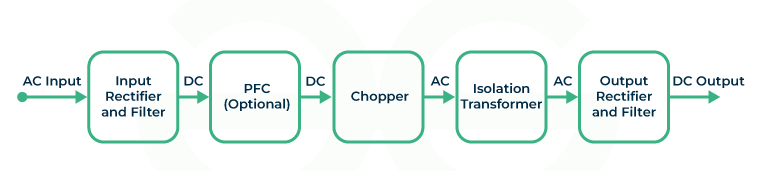
- At the first stage, a rectifier and a filter are used to convert the incoming AC power to DC.
- Since SMPS operates at high frequencies, the DC signal is processed by a high-frequency switch to produce a pulsed DC signal at medium frequency.
- A power transformer reduces the high-voltage DC output to a DC signal at appropriate level.
- Rectification and filtering of the dropped DC signal ensures a constant and continuous DC output.
- The control circuit continuously monitors the generated voltage and adjusts the high frequency switch to guarantee a continuous output flow at the desired voltage.
Types of SMPS Circuits
AC-DC Converter SMPS
The input source of this type of SMPS is AC, while its output is DC. AC power is converted to DC using rectifiers and filters. This irregular DC voltage is applied to the affected circuits for power factor correction. This happens due to low current pulses occurring in the rectifier near the voltage peak.
DC-DC Converter SMPS
The input source of this power supply comes directly from a DC power supply that provides high voltage DC power. Then, the frequency of this high–voltage DC power supply is reduced to 15 kHz-5 kHz. Afterwards, a 50 Hz reducer is transmitted to the transformer unit. The output of this transformer supplies the input of the rectifier, while the output of the rectifier supplies the power drawn by the loads. When the oscillator is regulated in time, a closed-circuit regulation is created. The transformer transfers its maximum power when the duty cycle is 50%. When the duty cycle is reduced the power of the transformer also decreases, reducing the outage as well.
Fly-Back Converter Type SMPS
An SMPS with a fly-back converter is an SMPS with an output power of less than 100W. The circuit of these SMPSs is simpler and easier to understand than other SMPS. The purpose of such SMPS is low power consumption. Using a MOSFET, the irregular voltage of constant density is converted to the desired output voltage by switching at a frequency of about 100 kHz. Voltage separation is performed using a transformer. An effective fly-back converter can be operated while the switch is controlled by PWM. Unlike a typical transformer, the fly-back transformer exhibits unique characteristics. The two windings that make up the fly-back transformer function like magnetically-connected inductors. To improve filtering, capacitors and diodes are used to spread the output of the transformer.
Forward Converter Type SMPS
This type of SMPS has almost the same design as the fly-back converter type. To control this type of SMPS, the switch is connected to the secondary winding that feeds the output of the transformer. The filtering and correction circuit is more complex than that of the fly-back converter. These SMPSs are commonly referred to as DC-DC buck converters and are used in transformer isolation and scaling applications.
Types of SMPS
Some of the most popular and widely used types of Switched-Mode Power Supplies (SMPS) for end users are:
DC-DC Conversion
The high voltage DC power received from the AC mains is rectified and filtered. Afterwards, this high DC voltage is switched and sent to the primary side reducer transformer. The rectified and filtered output is collected on the secondary side of the reducing transformer and then supplied to the power supply as an output.
Advanced Conversion
In advanced converters, the choke (inductor) carries the current whether the transistor is in active transmission or not. When the transistor is turned off, the diode inside the device transmits current to continue the energy flow on the load. Some of the electrical energy passes over the load when the transistor is on and is stored by the choke.
Flyback Converter
In the flyback converter, the magnetic field of the inductor stores energy when the switch is on. When the switch remains in “on” position, the energy is released into the resulting voltage circuit. The output voltage in the flyback converter depends on the Duty Cycle.
Self-Oscillating Flyback Converter
It works based on flyback theory. As the current passes through the primary winding of the transformer, it increases linearly in the Vin/Lp slope. The quick-return diode starts reverse-pole operation due to the voltage induced in the second winding and feedback winding, and keeps the transistors in the transmission switched on. When the current reaches its maximum value, the core reaches saturation. Therefore, the fixed-base motor supported by the input windings cannot withstand a sudden current increase, and the switching begins to exit saturation.
Advantages and Disadvantages of SMPS
Advantages:
- SMPS has a relatively light structure.
- The production spectrum of SMPS is wide.
- The switched power supply has a compact size.
- It is strongly anti-interference.
- SMPS is usually recommended for energy consumptions between 60% to 70%.
Disadvantages:
- The complexity of SMPS is very high.
- There is only one voltage output in SMPS.
- The SMPS control is weak, and the output fluctuation is high.
- The production reflection of SMPS is large and its control is insufficient.
- The use of SMPS is usually limited to reductive regulation.
SMPS Applications
- Its main areas of applications are those in power stations, refrigerators, furnaces and PCs.
- The frequency converters can be used to convert DC voltages to DC, and AC voltages to AC.
- They are used to provide variable power and voltage in factories and manufacturing facilities.
- They are also used in power plants, servers, airports, railways, security systems and railways.
- They can also be found in modern smartphones.
- Another area of application is for uncontrolled DC input voltage compensation.
- They are used in electrical machines.
- The automotive industry also uses SMPS devices.
- The purpose of SMPS is to balance the excess current and stabilize the electric current.
- They are compatible with electromagnetic fields.
- The high efficiency of SMPS is attributed to continuous input-output switching, which prevents the excess power from being wasted as heat. The voltages in the SMPS circuit change constantly as the circuit works by switching. The switching device is operated in either cut-off or saturation mode. The switching time of the feedback circuit regulates the output voltage. The duty cycle settings are made to change the switching time.
