


Renewable Energy and Electric Vehicles: Critical Steps For a Sustainable Future

Today, with the increasing awareness on environment and energy efficiency, the use of renewable energy sources and electric vehicles is rapidly becoming widespread. Renewable energy sources such as solar, wind and hydroelectric power increase energy security, while also minimizing environmental impacts by creating a sustainable energy supply system. In this regard, electric vehicles also offer a clean transportation alternative by reducing the dependence on fossil fuels.
The integration of renewable energy systems not only provides environmental benefits, but also improves the balance of energy production and consumption. While electric vehicles minimize the harmful effects of fossil fuels on the environment, they also offer a superior experience to users with longer range, fast charging and lower maintenance costs, with the further advances in battery technologies. These developments are one of the major factors shaping the transportation infrastructure of the future.
Battery Management Systems: The Powerful Signature of Technology
Rapid advances in battery technologies have enabled the use of batteries with higher energy density, less weight and longer service life in a wide range of products, from portable electronic devices to plug-in hybrid and fully electric vehicles. This means a longer usage time for mobile devices and wider range and more effective performance for electric vehicles, while also symbolizing the progress towards an environmentally friendly energy storage solution.
A Battery Management System (BMS) is an electronic system that regulates the charging and discharging of a rechargeable battery
system and its cells. This system protects the safety and performance of the battery by continuously monitoring values such as current, voltage and temperature in the battery pack and automatically intervening if these values fall outside the specified intervals. In addition, each cell of the battery must be balanced to extend the battery life and ensure safe use. This is one of the most critical functions of BMS.
History and Progress of Battery Management Systems
The evolution of battery management systems is actually quite old. The first steps were taken in the 1960s, and the systems then had a
simple structure. However, with the advances in computer technologies, the battery management systems have become more complex and started to offer more control and efficiency. In the 1980s and 1990s, with the developments in battery technologies, the battery management systems were further optimized and the safety standards were further raised. In the 2000s, with the rise of deep learning models and artificial intelligence technologies, the battery management systems have become smarter and more customizable. In this way, the batteries have become more efficient and their service life has been further extended. In addition, the efficiency of energy storage systems has increased with the optimization of battery charging and discharging via the grid, and significant improvements have been recorded in the field of energy demand management. Recently, on the other hand, battery management systems have become complex systems that can work dynamically based on the needs of users and optimize energy consumption. Intelligent battery management systems are used in a wide range from electric vehicles to solar energy systems, making it possible to use energy more safely and efficiently. These systems provide both economic and environmental benefits by ensuring that the batteries operate at maximum capacity.
Let’s Delve into BMS More…
Battery packs are produced by connecting the cells in series or parallel to achieve different configurations. Serial connections usually determine the voltage (V) of the battery, while parallel connections determine the current (A) and capacity (Ah) that can be drawn. Battery management systems in different configurations are used to ensure that the cells can work harmoniously with each other.
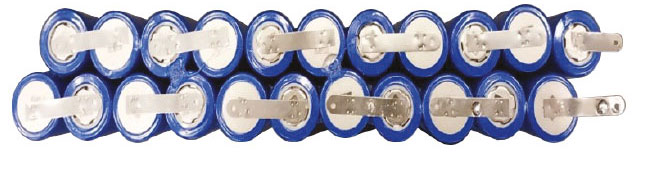
22-piece Serial Connected Battery Pack
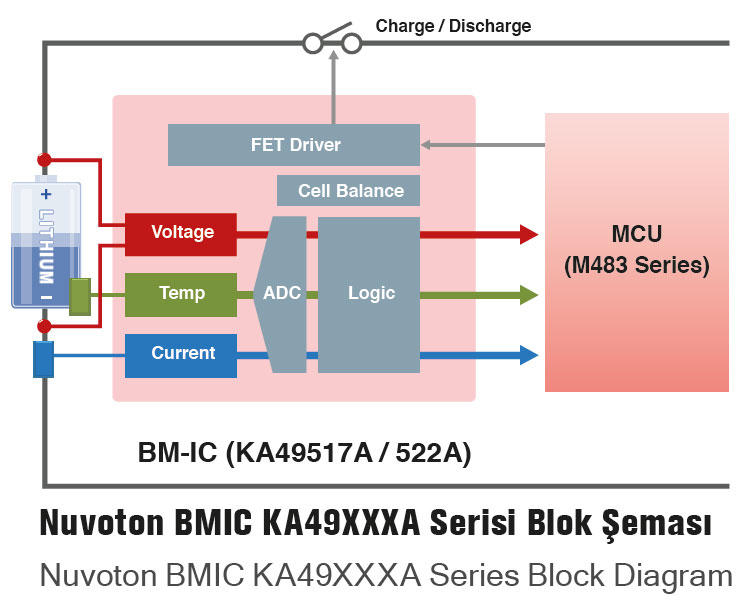
Management Systems is to protect the cells or the battery against potential hazards such as short circuits, overvoltage, overcharging, as well as to extend the life of the battery and make it function in a way that will meet the requirements of the application
in hand.
For instance, Nuvoton’s battery management integration can manage 22 Li-ion cells in series. A cell monitor monitors all the cell voltages and balances the voltage between them. This is called “balancing”. In addition to voltage data, it can also read current and temperature data instantaneously as shown in the block diagram, protecting the circuit against many faults or hazards that mayoccur.
What are State of Charge (SOC) and State of Health (SOH)?
State of Charge (SOC) is the ratio of the amount of usable charge in a battery to the full capacity of the battery. The SOC is important for determining how much energy the battery has. On the other hand, State of Health (SOH) is the ratio of the current capacity of the battery to its capacity when it was originally manufactured. Batteries may lose their performance over time due to repetitive charging/discharging processes and environmental conditions. Therefore, SOH is just as important as SOC for the long-term efficiency and safety of the battery.
The SOC value of a battery is highly dependent on factors such as battery temperature and battery current. Although the cell voltage is usually an indicator of the SOC value, the cell voltage alone is not enough to provide a reliable SOC estimate. For an accurate SOC estimation, the battery temperature, battery current and battery voltage values must be evaluated together. This is a critical parameter for proper monitoring and management of the battery. The balance between SOC and SOH is critical for the success of battery management systems. In order for a battery to operate efficiently and safely, both the state of charge (SOC) and the state of health (SOH) must be accurately monitored and managed.
Balancing in Batteries
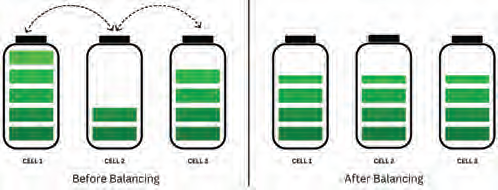
Although the lithium cells undergo similar processes in the factory, they are not completely identical in practice. This is due to the structural differences of the battery packs used and the thermal stresses caused by the positions of the cells within the pack. This leads to the formation of differences in the anode, cathode and electrolyte structures between the cells connected in series over time. Even if it is assumed that the same current passes through during charging and discharging, the charge levels of cells differ, and therefore the equality in cell voltages may be disturbed. Differences between 100 mV to 200 mV may occur between the battery pack cells in time. These differences lead to early interruption of the charge during charging due to cells whose voltage remains high and therefore the State of Charge (SoC) level is higher. On the other hand, cells with low SoC levels discharge earlier, causing early interruption of discharge.
This imbalance causes the activation of overvoltage protection (OVP) and undervoltage protection (UVP) functions of the Battery Management System, which are actually the main functions of the system. As a result, the usable energy (i.e. Ah capacity) of the battery pack may be lower than that of a balanced battery pack. In order to eliminate such imbalances and optimize the battery performance, the voltage balance between the cells in the battery pack is recreated, which is called “Cell Balancing”. Cell balancing is a very important process in battery management systems.
Types of Cell Balancing
Cell balancing is usually performed by two main methods: Passive Balancing and Active Balancing.
Passive Balancing
Passive balancing is a widely used method in battery management systems. In this method, a serial resistor connected with a switch (semiconductor) is placed at the positive (+) and negative (-) ends of each cell. BMS measures the voltages of cells and detects the
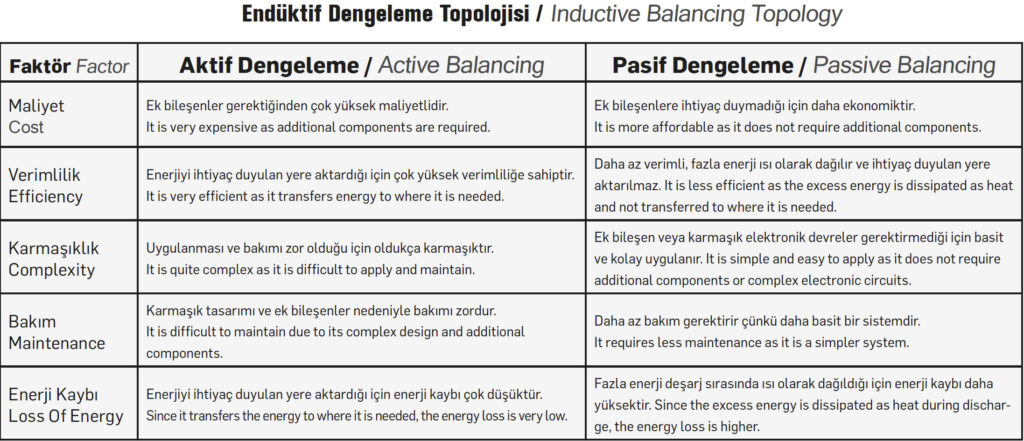
voltage differences between cells. After voltage differences are detected, the BMS checks the switches and activates the switches that are connected to cells whose voltage remains above the average. With this process, current is passed through the cells carrying excess energy and this energy is consumed on the resistor. In this process, the energy of the cell is discharged with a certain force for a certain period of time. As the energy of the cell decreases, its voltage also decreases. However, an important challenge in passive balancing is to effectively dissipate the heat generated on the resistor. Due to energy consumption, heating occurs on the resistor and leads to a buildup of heat on the circuit board that is difficult to dissipate. Therefore, it may be necessary to use cooling systems or special materials to ensure smooth dissipation of heat in passive balancing circuits. This is also a factor that increases the complexity and cost of the system.
Passive balancing offers a cost-effective and simpler solution, but it is more limited in terms of efficiency as the excess energy is usually
converted into heat and lost. This may negatively affect the overall energy efficiency of the batteries.

Active Balancing
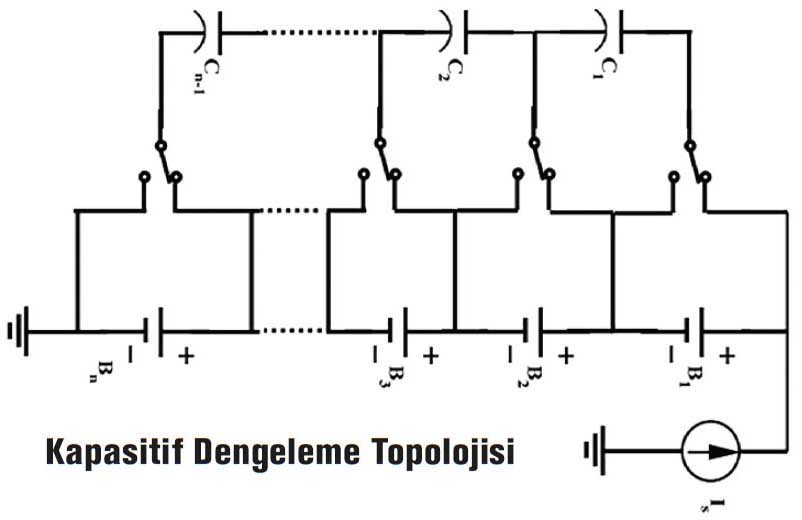
Active balancing, on the other hand, requires the transfer of excess energy from highly charged cells to low-charged cells. Numerous
techniques including capacitive balancing (in which the energy is transmitted through a capacitor) and inductive balancing (in which the
energy is transmitted through an inductor) can be used to achieve this. Active balancing is more effective than passive balancing as it
does not waste much energy, but it is also more difficult and expensive.
Capacitive Balancing
It is based on the principle of alternating connection of capacitors to neighboring cells for a certain period of time. In this method called the “Flying Capacitor” it is necessary to use very low internal resistance (ESR) capacitors. This requires the use of suitable semiconductor switches, as it causes instantaneous high currents to pass through during switching.
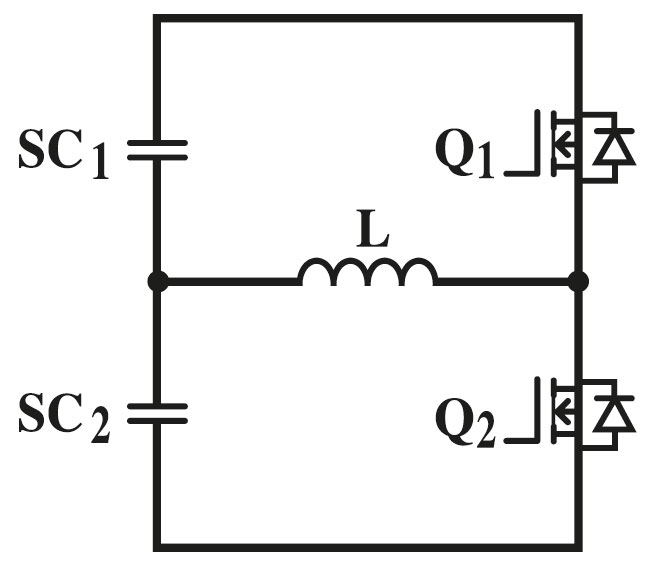
Inductive Balancing
In this structure, the energy transfer between neighboring cells is carried out by a buck/boost circuit. In this circuit, the load is transferred through the inductance (coil).
A Giant in the BMS Industry: Nuvoton
In 2019, Nuvoton took an important step by purchasing Panasonic’s semiconductor unit. With this acquisition, Panasonic’s battery management systems (BMS) also joined Nuvoton. Nuvoton, which was not previously involved in the BMS sector, has gained a new momentum in the sector by incorporating Panasonic’s high-quality semiconductor technologies after this merger.
With the joining of Panasonic’s semiconductor unit to Nuvoton, the company’s product range has become much broader and powerful. Nuvoton’s BMS solutions offer optimized and customized solutions for electric vehicles, energy storage systems, portable devices and many other applications. These solutions have been developed in accordance with industry standards and exhibit superior performance in terms of reliability, efficiency and safety.
Nuvoton BMS Solutions
We can sort Nuvoton’s BMS solutions under three main classes: Automotive Certified: Solutions designed for electric vehicles that meet high safety and performance requirements. Stackable: Stackable solutions in which multiple battery cells can be used together. Non-Stackable: Suitable solutions for non-stackable simpler structures, as well as the applications with low number of cells.
Automotive Certified
For lithium-ion batteries in electric vehicles, it is essential to ensure high safety against dangerous events such as smoke and fire.
Nuvoton’s automotive certified KA849XXUA Series BMSs are specially designed to meet these requirements. This system includes a measurement system in which the functional blocks are electrically separated and have a highly redundant communication topology to ensure reliability with high safety. This feature makes it easier for customers to design and develop an automotive battery system that complies with ISO 26262 ASIL-D standard. High accurate voltage measurement contributes to increasing the mileage for Battery Electric Vehicles (BEV). Moreover, the guaranteed voltage measurement error over wide input voltage ranges and wide temperature ranges allows to provide a common platform for different vehicle models and applications. These BMS solutions represent an important step towards ensuring safety, efficiency and long-lasting performance for electric vehicles.
Stackable
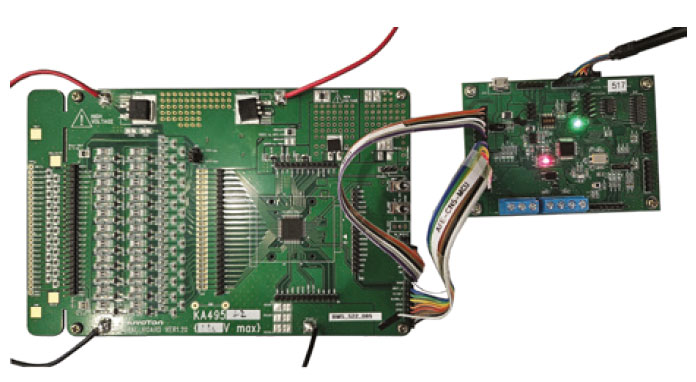
It may be necessary to connect a large number of batteries in series to provide the required energy for high-voltage energy storage systems or electric vehicles. At this point, Nuvoton’s KA496XX series comes into play. The integrations in this product group can be connected to each other in series and controlled by a main processor. This provides the extensibility and modularity of the battery management system, providing solutions suitable for different applications.
Non-Stackable
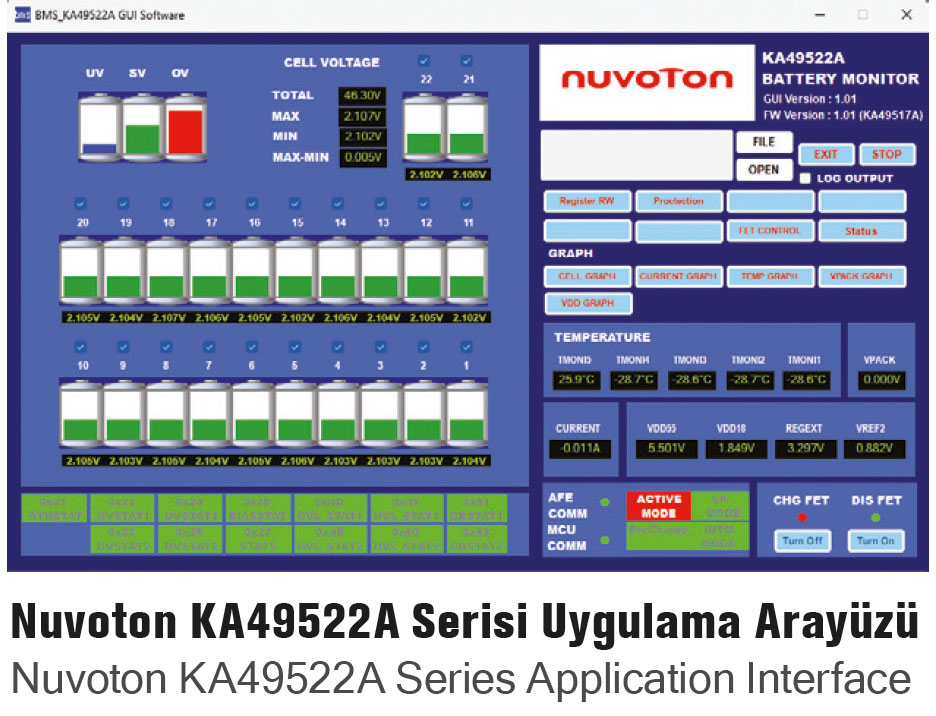
Nuvoton’s KA495XXA Series BMSs are equipped with highresolution ADC (Analog-to-Digital Converter) and accurately measures the battery cell voltage and current. The Non-Stackable series includes the necessary built-in regulator for peripheral circuits. With this, the users can easily create the cell balancing switch, charge and discharge controls. This series is ideal for applications requiring simpler and compact solutions, allowing the users to configure their systems even more quickly and efficiently. These two series highlight the diversity and flexibility of Nuvoton’s BMS solutions by offering modular features optimized for different cases of use.
