


LED TECHNOLOGIES SALES MANAGER
One of the most popular topics of the LED industry recently is “Horticultural Lighting”. Although the LED-based SSL products have the potential to offer groundbreaking benefits in plant cultivation applications at buildings and greenhouses, there is still much to be learned about the different lighting needs of different plant species, or the changes in lighting requirements during the growth cycle of a plant. Unfortunately, there is not much public information about the practices, as the lighting manufacturers who want to invest in this field have intellectual property rights that they don’t want to share with public. In the next few issues, we will share with you the information we have compiled by now about the researches conducted, application requirements and the terminology used, in order to fill the existing gaps in this field.
The plants’ need for light is different than that of humans. Also, plants have circadian cycles that are different from those of humans and vary widely from species to species. Therefore, human-oriented measurements such as yield or CRI may not mean anything about whether an LED fixture would produce good results for vegetable and flower growers. For this reason, many researchers around the world are conducting studies to find out what is the “ideal light recipe” or “growth environment” for plants. Of course, since most of these studies are still at early stages, it is quite difficult to claim that useful results are soon to be obtained for the moment. Nevertheless, the fact that many LED manufacturers have started to launch new products in this field shows that such works will increase exponentially and more information will be available in a near future.
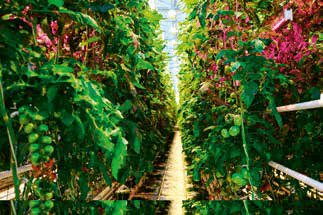
In the past, artificial lighting, mostly achieved with high-pressure sodium (HPS) lamps, was used in greenhouses to prolong the tomato growing seasons. Unlike these products, one of the major advantages of LED fixtures is that they can be used horizontally or vertically between plants, or at closer distances due to their low heat generation. Thanks to this, it is now possible to transmit light to the lower leaves, which start to be unable to receive light from above as the plant grows. Offering several other advantages such as energy efficiency, spectrum controllability, little to no maintenance requirement, and the ability to use the same fixture also for personal lighting, the LED fixtures have started to replace conventional sodium and metal lamps rapidly.
“One of the major advantages of LED fixtures is that they can be used horizontally or vertically between plants, or at closer distances due to their low heat generation.”
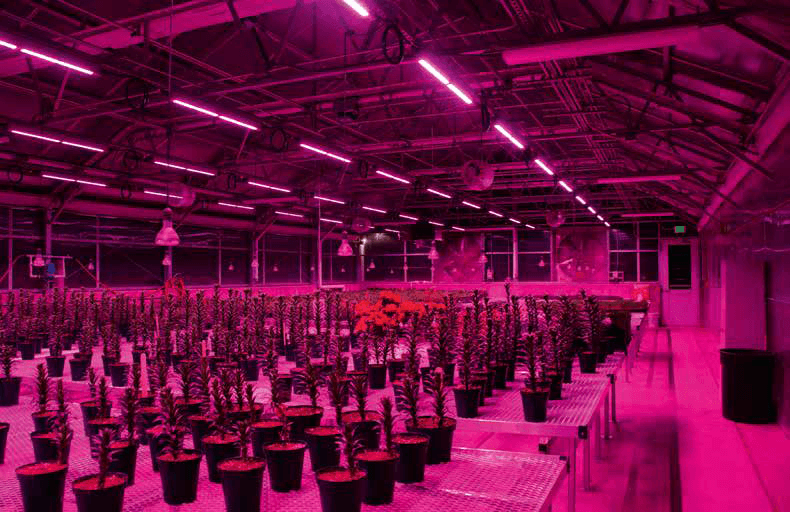
However, the growers still need certain criteria that can distinguish whether a fixture offers the ideal combination of density and spectral power distribution (SPD), in order to choose the correct product and achieve the best yields. Answering such questions asked by the growers to lighting manufacturers about this selection process is quite difficult for now. For instance, looking at the studies about LED fixtures used in plant cultivation 6-7 years ago, we see that chlorophyll absorption due to spectral power is mainly focused on, as chlorophyll is the key for photosynthesis. Laboratory studies had shown that the energy peaks in the blue and red spectrum corresponded to the absorption peaks, while green had no effect on absorption. The result of this research has caused the market to be flooded with fixtures that give pink or purplish light obtained through the use of monochrome red and blue LEDs.
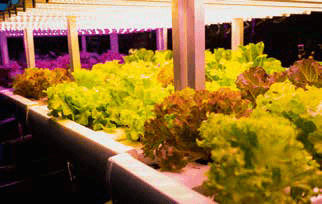
According to the current belief, on the other hand, while the blue and red spectrum provide the highest energy, the lighting fixtures that can offer a wide spectrum, such as the sunlight, provide better results. Therefore, wide–spectrum white LEDs, as well as deep–blue, deep–red and far-red LEDs are used in today’s fixtures, and even UV LEDs are used in some applications. As a result, it seems that the use of red, blue and broad-spectrum white LEDs together has become the standard in current fixtures. The ability to use the white LEDs as lighting elements during crop inspection or harvest times is also a plus. When meaningful results start to be obtained from the ongoing researches about which spectrum and density are required for which plant at which stage, we will also be able to achieve higher yields, better qualities or more delicious crops, thanks to the fixtures specific to that type of plant.
