


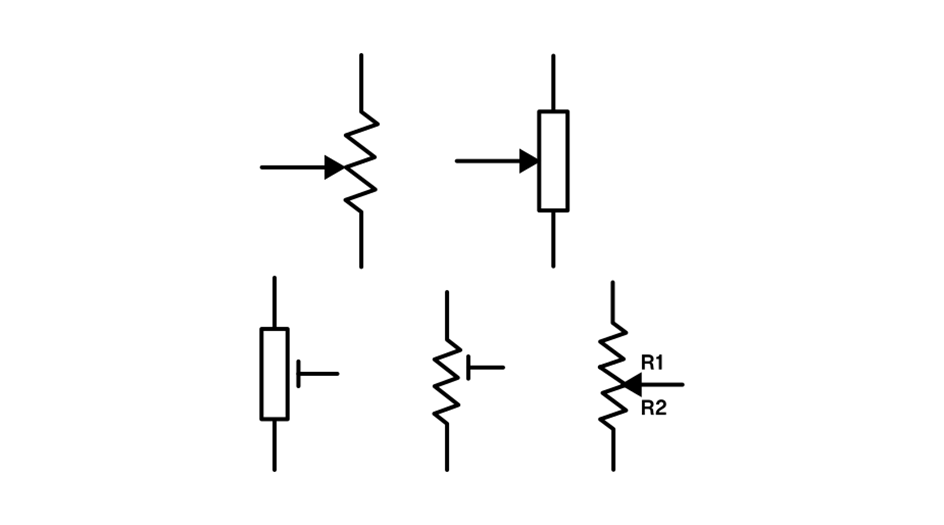
What is a Potentiometer?
Potentiometer is a type of resistor commonly known as a “Pot”, which includes a mechanical adjustment mechanism to be able to manually change the resistance. As we know, resistors offer a constant resistance value and block or “resist” the electricity flow in a circuit. Potentiometers, on the other hand, are actually variable resistors.
Potentiometers function as voltage dividers, which are used to set the output voltage to a circuit and precisely measure the electrical potential. In fact, they are named after this. They generate a continuously variable voltage output signal proportional to the physical position of the slide on the resistor element. Potentiometers are passive components, meaning they do not need a power supply or additional circuits to operate.
A Brief History of Potentiometers
With the surge in research and development activities on electricity in the early 1800s, the concept idea of a component that could control the amount of electricity entering a device or circuit was explored by many people. However, the potentiometer concept was not proposed until 1841. The first working carbon potentiometer was invented by Thomas Edison in 1872.
The potentiometers today are significantly smaller and more sensitive than their previous equivalents. They are available in many different types and case types depending on the application. Potentiometers are often used in devices and systems to control values such as light levels, volume and audio signals, as well as video brightness and color. They can also function as a position sensor.
How Do Potentiometers Work?
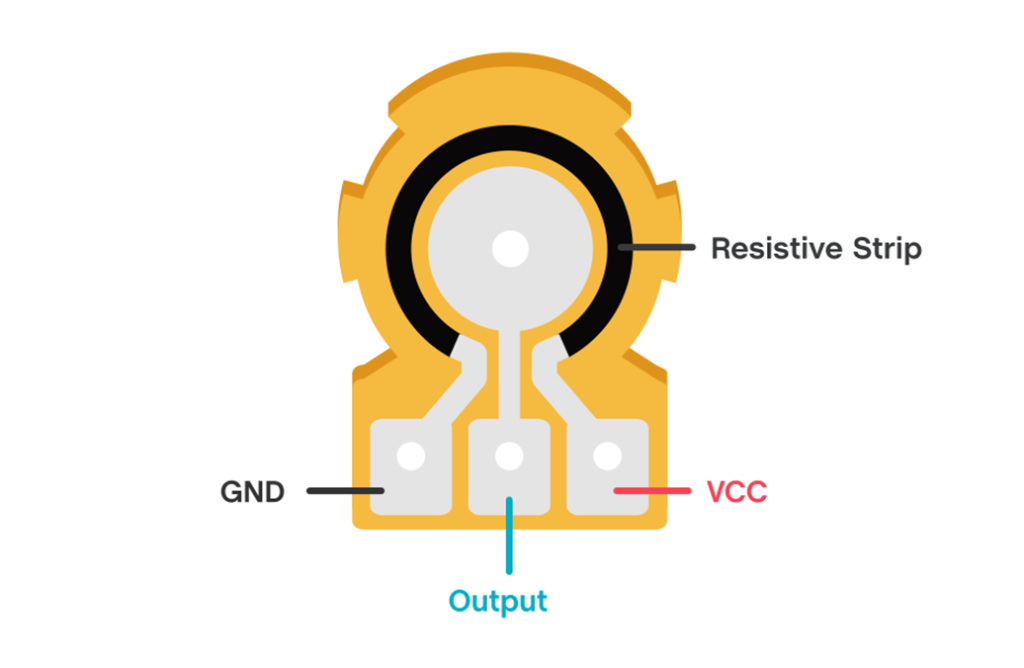
The resistance of an object depends on several factors. When all other conditions are kept constant, the resistance of an object is directly proportional to its length. In other words, an object made of same material and in same cross-sectional size would have half the resistance of an object 20 cm long, when it is 10 cm long. Potentiometers use this principle.
The adjustable output of the potentiometer is obtained by changing the linear or rotating position of a sliding contact on a uniform resistance element. This shortens or lengthens the path through which the current passes. The input voltage is applied to the entire length of the resistance element, and the output voltage is obtained as the voltage drop between the stationary resistance element and the sliding or rotating contact point. The position of the moving contact on the resistor element determines the amount of input voltage to be applied to the circuit.
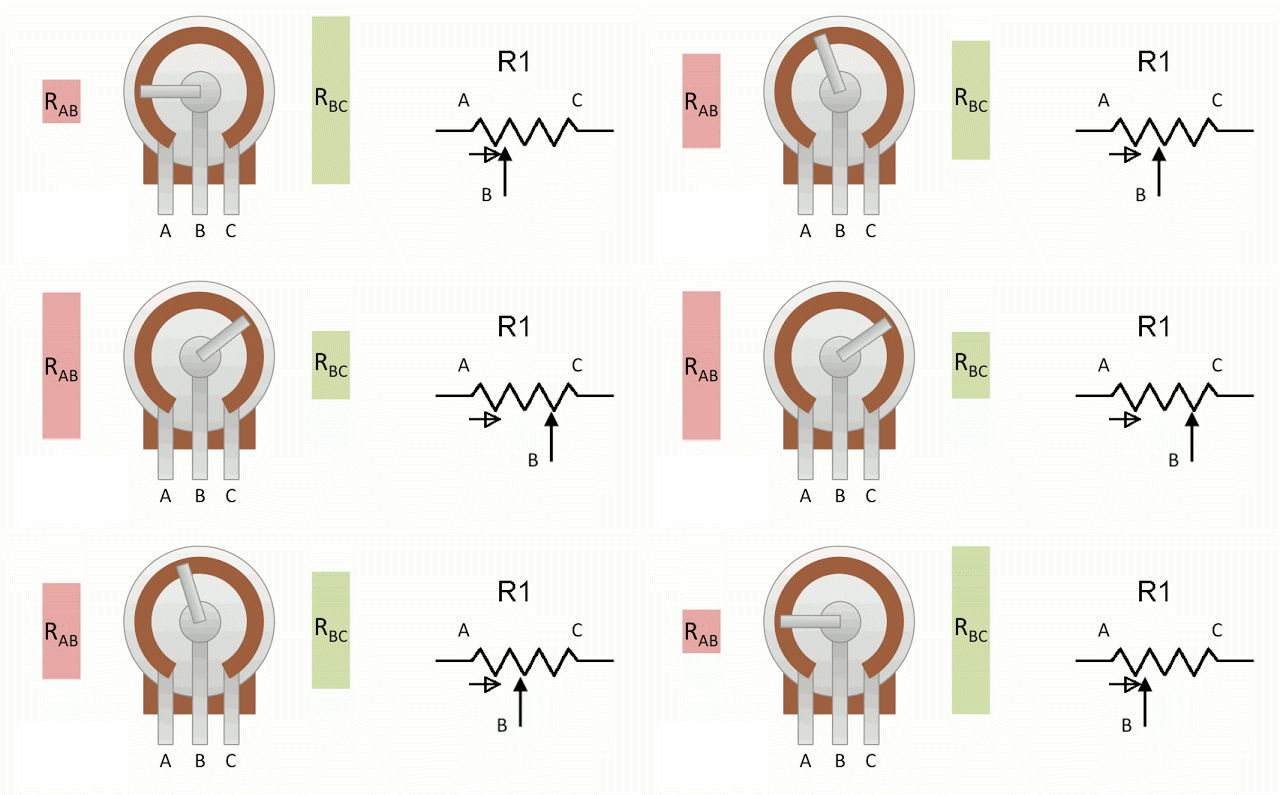
Potentiometers are usually not used to control more than one watt of power, as the device is forced to distribute the input power, and this generates unacceptable heat levels. Instead, they operate by tuning analog signals used by other components to control power. For instance, a simple light dimmer uses a potentiometer to control a TRIAC, and this changes the light brightness.
Types of Potentiometers
Potentiometers are available in two major forms: Analog and digital. Conventional analog potentiometers use mechanical elements that can be manually adjusted to control the output. Analog potentiometers are available in linear and rotary formats:
Comparison of Linear and Rotary Potentiometers
Rotary potentiometers use a rotating knob, which is connected with a slider element, as well as the angular motion of the shaft. This sliding element acts on the resistance element. Rotating the shaft changes the resistance and output. Potentiometers can also have a shaftless design, in which the slide is moved using an external tool (for example, a screwdriver) instead of a shaft. Such potentiometers are usually called “trimmer potentiometers”.
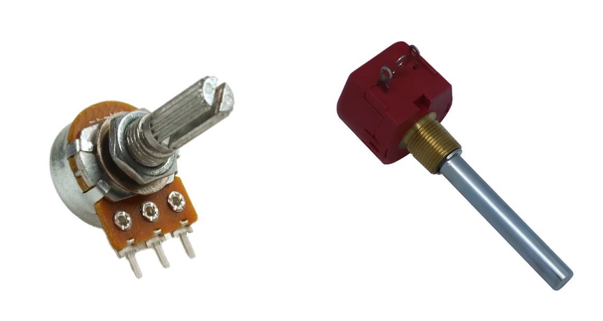
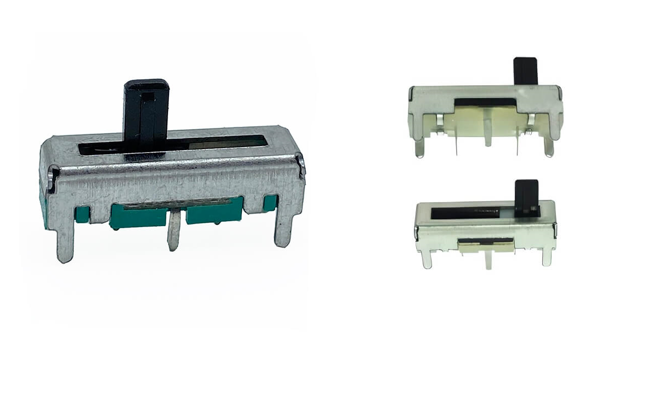
Linear (linear) potentiometers make a linear contact (along a straight line) with the resistance element through a slider and changes the resistance and output in this way.
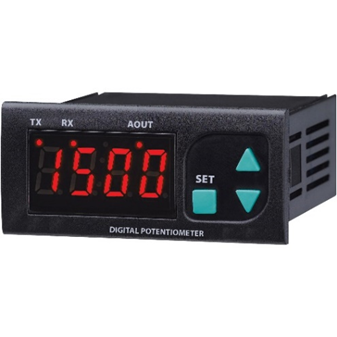
Digital or electronic potentiometers are controlled by digital signals instead of mechanical movement to change the output. In this article, we will focus on analog potentiometers.
Subtypes of Potentiometers
There are various subtypes of analog potentiometers available in linear and rotary formats, and they can be customized according to the application. These include:
- Presets and Trimmers: They are small devices, usually mounted on the circuit board and adjusted with a small screwdriver. They are used for adjustment and calibration in circuits. Presets have certain values, while trimmers offer high resolution thanks to multi-turn screws. They are mostly used during system calibration and often remain in a fixed position.
- Dual Gang: It consists of two potentiometers combined on the same shaft and allows two channels to be adjusted in parallel.
- Servo Pot: It is a potentiometer connected with a rotating shaft (motor). It can detect the position by measuring the pulse that makes the motor rotate. The motor movement stops when the potentiometer indicates that the position corresponds to the incoming pulse. It is usually used in robotic applications or where precise motion control is required.
- Logarithmic: As the potentiometer is adjusted, its resistance changes logarithmically, which adapts to the logarithmic sound response of the human ear. It is used for volume control in audio equipment.
- Concentric: They are two rotary potentiometers placed on top of each other, with shafts on the same axis. This design allows for controlling the level and tone of sound through a single mounting hole.
- Thumbwheel: It uses a rotary wheel with a tactile edge that allows the device to be adjusted with a fingertip. It is usually used for sound and brightness controls.
- Slide and Dual Slide: It uses a resistance element and a slider contact that adjusts the resistance with linear motion. It offers a linear relationship between the slider position and the output resistance, and therefore can also be used as resistive position sensors (linear displacement sensors). Dual slide potentiometers have a single slide that controls two potentiometers in parallel. It is often used in studio mixing devices, faders or graphic equalizers.
- Motorized Slide: The time band is a slide potentiometer powered by a small DC motor and a timing pulley. It can be used for remote automatic control. It is usually used in industrial automation and process control applications.
- Single-Turn and Multi-Turn: Single-turn pots provide sufficient control resolution by offering a full rotation of the control knob of about ¾. Multi-turn pots, on the other hand, allow multiple turns of the control knob and provide greater sensitivity in cases where high resolution is required.
Resistance Values and Other Parameters of Potentiometers
Potentiometers are usually rated and indicated by their total resistance value. This resistance value refers to the resistance element from one end terminal to the other. For instance, there is a constant 1 kΩ resistance along the track of a potentiometer rated at 1 kΩ.
Other parameters that should be taken into account when choosing a potentiometer are:
- Rated Power: The maximum power that the device can handle without any damage.
- Resolution: The accuracy of the potentiometer is expressed as a percentage of the total resistance and shows the amount of resistance that changes with each incremental movement of the contact in the resistance element.
- Sliding Noise: The amount of electronic noise caused by the movement of internal contact parts.
- Temperature Factor: It is how the observed resistance may vary depending on the operating temperature of the device.
- Mechanical Life: The service life of the device according to the specifications is usually expressed as the “number of cycles”.
About the Potentiometer Taper Feature
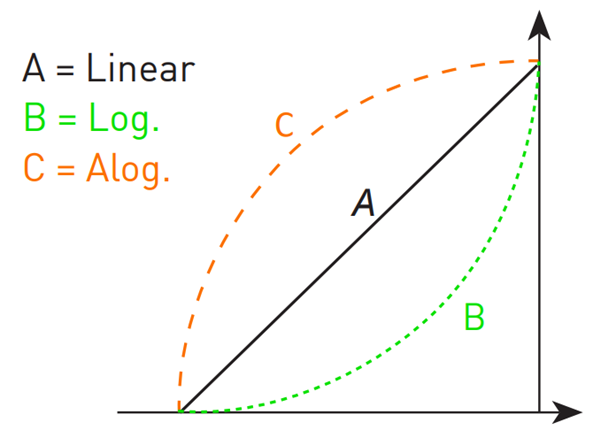
The potentiometer taper refers to how the resistance changes as the device’s armature rotates or its slide moves on the resistance element. In some potentiometer designs, this relationship is linear. In other words, when the armature or slide is in the middle position, the variable resistance is half of the full-scale resistance of the potentiometer.
Other designs offer a non-linear, logarithmic taper (also called a “sound taper”). This taper mimics the logarithmic sound response of the human ear more closely. This gives the impression of a more balanced sound level adjustment during the full rotation or scrolling of a volume controller.
Reverse logarithmic potentiometers are also available, which have a design that works in reverse. Such potentiometers are used, for instance, in volume controls that operate counterclockwise.
The following is the graph indicating the potentiometer taper differences;
What is the Differences Between Potentiometers and Rheostats?
Potentiometers are three-terminal devices used for voltage control, while rheostats are two-terminal devices used for current control. However, it is possible to use potentiometers as rheostats by not connecting one leg of the potentiometer.
Schematic Differences Between Potentiometers and Rheostats;
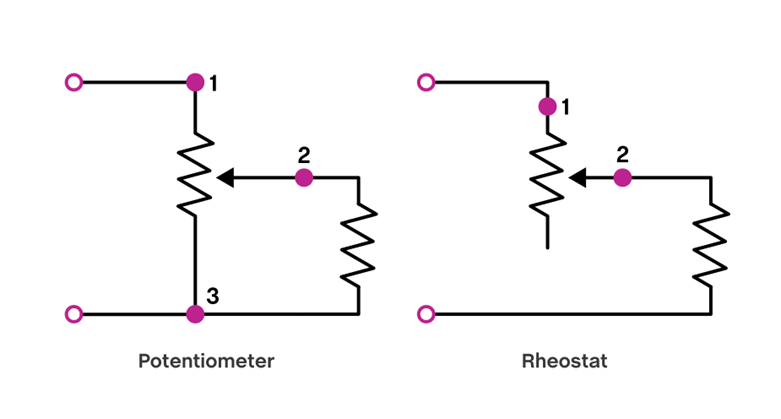
Potentiometers are usually used for voltage control, while rheostats are wire-wound variable resistors with a high Wattage value and are used to control current flow in high current applications. For instance, they control the current flowing to devices such as lamps and motors. Rheostats are defined not according to their resistance values but according to their capacity to bear to large power levels.
Rheostats contain coils of heavy-duty wires that change the resistance value step by step by changing the position of the sliding element on the resistance element.
