FIELD APPLICATION ENGINEER
With the development of electronic technologies, new application areas addressing our visual senses have emerged. In particular, the end point of LED, LCD and TFT technologies is making significant contributions to the electronics sector. In this article, we will talk about the types of electronic indicators that are often used in today’s applications, as well as their technologies. Indicators are divided into three types according to the materials used: TFTs, LED and LCD indicators. LED (Light Emitting Diode), a type of diode, emits visible light to the outside when energy is supplied according to the content of the semiconductor material it contains. While LCD (Liquid Crystal Display) works on the principle of passing the light of a single phase of an electrically polarized liquid, TFTs (Thin Film Transistor) create the image thanks to the transistors placed between 1 and 4 per pixel. Indicators have a wide range of uses. Selecting an indicator suitable for the application in hand is very important in order for the design to be long-lasting, stable and work correctly. The following parameters can be taken into account when selecting an indicator.
“In order for the design to be both long-lasting and stable, and to work correctly,
the selection of appropriate indicators for the work to be performed is essential.”
1. LED Indicators
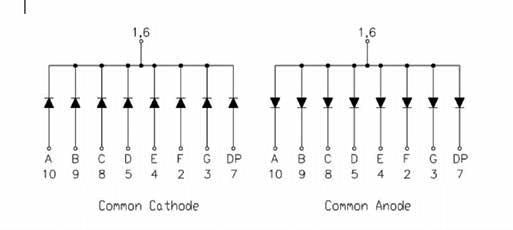
LED indicators are the simplest and cheapest type of indicator. A collection of LED cells that contain segments in their content and can indicate a meaningful expression is called “digit”. LED indicators are manufactured as common anode or common cathode. Indicators with a common anode are powered from a single power source, while indicators with a common cathode have specific ground pins connected jointly and each pin is energized separately. In the image below, you can see the common anode and common cathode connections. In general, the types of LED indicators that work on the principle of illuminating the required LED segment by connecting with a serial front resistor are also classified among themselves.
7-Segment LED Indicators
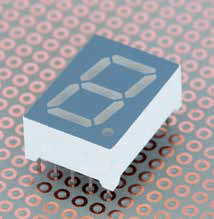
7-Segment LED indicators are the types of indicators we are most familiar with in our daily life. In these types of indicators, which are used in many areas from digital clocks to panels, all the digits from 0 to 9 can be printed by energizing the necessary LED segments. The reason it is called a 7-Segment is that it consists of 7 LED segments and also an LED segment for the dot together.
14-Segment LED Indicators
Unlike 7-Segment LED indicators, it is a product designed for printing letters in addition to the numbers, with a 14-Segment LED embedded in its content, and is not different from 7-Segment indicators in terms of operation.
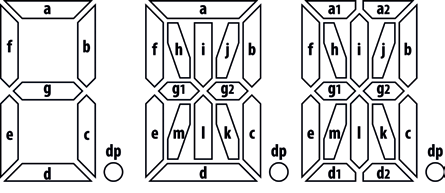

Alphanumeric LED Indicators
It is a model designed in the form of 4 LED bars by dividing the two LED bars parallel to each other on the upper and lower sides of the 14-Segment LED indicators separately. In this way, it is possible to produce different combinations on the indicator. For a digit, you can see the comparison of 7-Segment, 14-Segment and Alphanumeric LED indicators above.
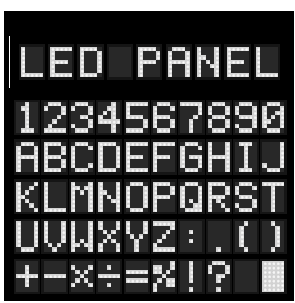
Dotmatrix LED Indicators
Dotmatrix LED Indicators, designed for situations where 7-Segment, 14-Segment and Alphanumeric indicators are not sufficient, are a set of sequential LEDs designed on the basis of matrices in 5×7, 4×4 or 8×8 sizes. The connections of these display types, which allow for the display of special characters such as +,- ? or ! in addition to numbers and letters, can be produced as anode row cathode column or cathode row anode column, apart from common anode or common cathode connections.
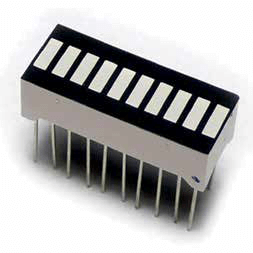
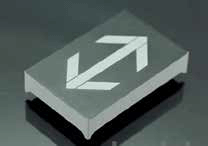
Bar Graphic Type LED Indicators
The areas of use are signalization boards indicating the directions or an array of LEDs arranged side by side to indicate a stage.
“The end point of LED, LCD and TFT technologies is making significant contributions to the electronics sector.”
2. LCD Indicators
LCD indicators are products obtained by combining and using a “liquid crystalline” liquid with the display, in cases where the applications made with LED indicators are insufficient. In general, LCD indicators, which are low in cost, are preferred in applications where there is no need to display too much information on the screen. Due to its simple structure, LCD products can be driven with a cheap 8-bit processor. Depending on the type of liquid crystal used, they can be in TN, HTN, STN and FSTN structures. There is also optional “touch support” for LCD indicators. LCD indicators are designed in monochrome, such as blue, green, yellow, red, amber, white and black. Its physical structure is divided into 3 as ”COB“, ”COG“, ”COF“, while its graphic structure is divided into 3 as ”Character LCD“, ”Graphic LCD“ and ”Special Design”.
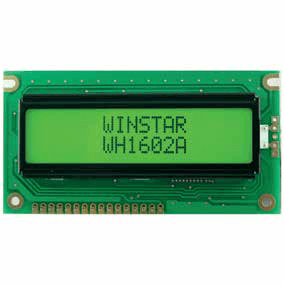
Character LCD Indicators
The LCD driver chip uses ready-made characters that are embedded in the ROM memory. The user can only print the desired character to the required row and column position by sending the address of the character they want to see on the screen via the processor. Character LCD indicators are produced in different row column ratios such as 16×2, 20×4, 8×1 etc. Ozdisan Elektronik offers professional solutions for character LCD indicators of Winstar company.
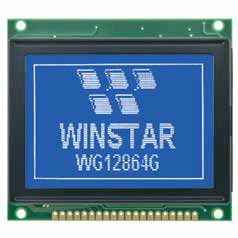
Graphic LCD Indicators
Unlike character LCD indicators, users can use it to show their own graphics on the screen other than standard characters. Many products with different resolutions are available at Ozdisan Elektronik.
Specially Designed LCD Indicators
If there are fixed symbols that are desired to be displayed on the screen and their locations do not change, a customer-specific screen can be designed. Such screens are usually preferred in high-volume projects.
3.TFT Indicators
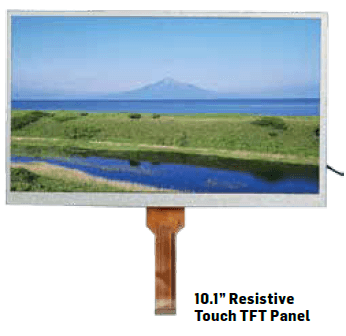
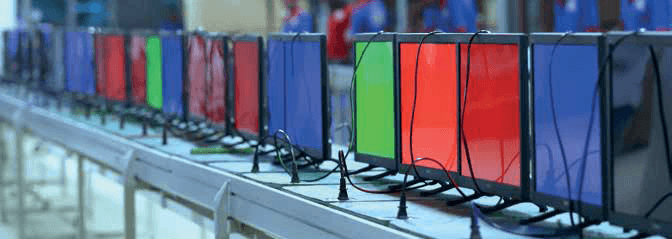
The image formed on the TFT glass becomes visible through the light coming from the back surface. The light is obtained by means of LEDs placed on the back surface. The layers placed behind the TFT glass ensure that the light spreads uniformly over the entire surface. When choosing a TFT display, the resolution, viewing angle, interface, brightness and touch type, if any, should be considered. TFT indicators with the desired characteristics can also be easily accessed via Ozdisan Elektronik. There are two types of TFT indicators available: Resistive Touch and Capacitive Touch. Applying a slight pressure to the screen is required for Resistive Touch detection. It is the cheapest, easy to use, more stable type of touch than Capacitive Touch in an environment where magnetic noise is high. In order for the Capacitive Touch to work, physical pressure on the screen is not required. A cover glass can be added to it for protection purposes. In this way, it is more durable than Resistive Touch. Single and multi-touch detection features bring Capacitive Touch to the forefront. There are driver boards in the Ozdisan Elektronik product range that can be used for TFT indicators of different sizes.
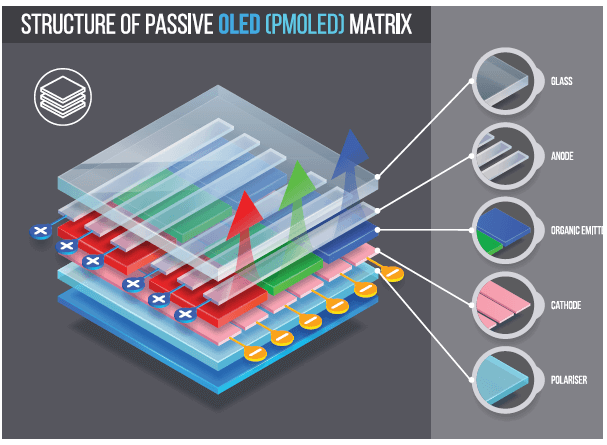
In addition to these, the developing OLED technology may replace LCD and TFTs in the future. OLED screens that work by illuminating the required pixel without the need for background lighting stand out with their low power consumption. In OLED display types, which have two types as PMOLED and AMOLED, PMOLED provides single color support, while AMOLED technology provides multi-color support.
“When choosing a TFT display, the resolution, viewing angle, interface,
brightness and touch type, if any, should be considered.”