


Innovative Steps In The Tech World: Boardoza and Maker Development Boards

As the technology world evolves rapidly, the role of companies offering innovative solutions becomes increasingly important in the industry. One such company leading this development is Boardoza. With its goal of making technology accessible to everyone, Boardoza enables users to achieve more efficient, creative, and effective use of technology through its products and services.
The maker development boards in Boardoza’s product ecosystem play a critical role in technology development processes. Designed for individuals and communities working on electronics and software-based projects, these versatile, user-friendly platforms enhance access to technology and lay the foundation for innovative projects. Widely used in both hobbyist projects and professional prototyping processes, maker development boards are tools that bring the evolution of technology to a level accessible to all.
Today, we will explore the Boarduino R3 and Boardoza Pulse S32-S3 boards available in the Boardoza product range and discover how their features can take your projects a step further.
General Features of Boarduino R3
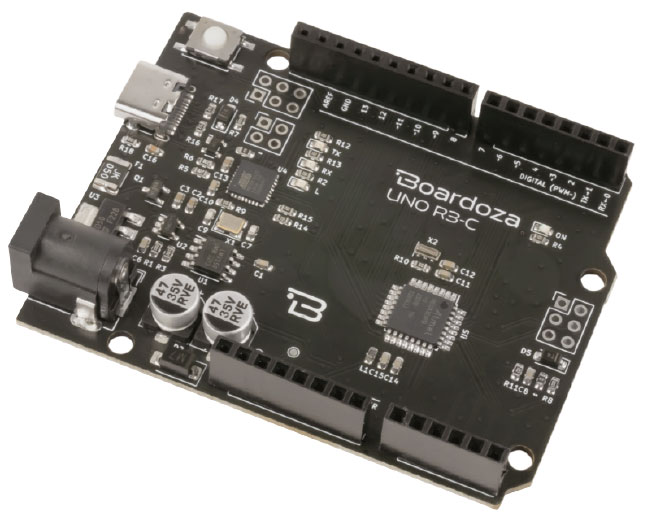
The Boarduino R3 is a compact and versatile microcontroller development board designed for a wide variety of projects. Powered by the ATmega328P microcontroller, this board offers an ideal platform for both beginners and experienced developers. With a 5V operating voltage, the Boarduino R3 can be powered with an input voltage ranging from 7V to 12V.
Technical Specifications and Applications of Boarduino R3
Input/Output Pins
The Boarduino R3 features a wide range of digital and analog input/output pins. Equipped with a total of 14 digital I/O pins and 6 analog input pins, this board offers great flexibility for developing your projects. The digital pins can be used to control LEDs, drive motors, or collect data from sensors, while the 6 analog input pins provide substantial flexibility for projects involving devices with analog outputs such as temperature or light sensors. This versatility allows the Boarduino R3 to support a wide array of applications.
Power and Current Management
The Boarduino R3 operates at 5V and can be powered through a USB connection or an external power source ranging from 7V to 12V. Each I/O pin can supply a current of 20mA DC, and the 3.3V pin can provide up to 50mA of current. This feature simplifies the integration of external devices and ensures compatibility with various sensors, motors, and other components. The Boarduino R3 allows you to power your prototypes both safely and efficiently.
Clock Speed and Built-in LED
The 16 MHz clock speed of the Boarduino R3 ensures that it operates at a sufficient speed for most applications. Additionally, the built-in LED on Pin 13 serves as a practical indicator for testing the basic functions of the board and accelerating debugging processes. This feature provides significant ease during prototype development and offers a user-friendly experience.
Applications and Example Uses
Hobby Projects
With its simplicity and versatility, the Boarduino R3 is an excellent choice for hobby projects and DIY (Do-It-Yourself) applications. It is commonly used in projects such as robot building, home automation systems, and interactive devices. The board is ideal for controlling components like PWM outputs, motors, and LEDs, offering a rich set of features for projects. As a result, the Boarduino R3 serves as the foundation for creative and functional hobby projects.
Prototyping and Learning
For beginners, the Boarduino R3 is an excellent starting point for embedded programming and microcontroller-based designs. Its compatibility with the Arduino ecosystem provides access to a wealth of educational materials, libraries, and community support. This support accelerates the learning process and allows users to quickly bring their projects to life. The Boarduino R3 is an ideal platform for both beginner and advanced learners, making it a popular choice for educational and research purposes.
Educational and Research Use of Boarduino R3
The Boarduino R3 offers an excellent platform for educational purposes, thanks to its simple design and powerful features. It is frequently chosen in classrooms for teaching fundamental electronics concepts such as digital input/output, PWM control, and analog-to-digital conversion. With the Boarduino R3, students can quickly test their circuits, enabling them to learn basic electronics and coding skills in practice.
Boardoza Pulse S32-S3 Development Board: General Features
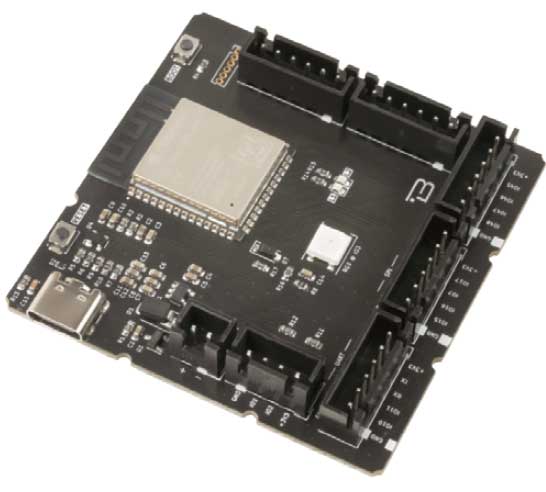
The Boardoza Pulse S32-S3 is a flexible and compact development board designed for embedded systems and Internet of Things (IoT) applications. With its very small 60 x 60 mm size, it provides significant advantages in prototyping and development processes with its multiple connectivity options and powerful features. The board can be powered either via a battery or a Type C connection, making it highly practical for both portable and fixed projects.
Key Technical Features
Power Options
The Boardoza Pulse S32-S3 operates at 3.3V DC, making it suitable for low-voltage systems. This feature allows for easy integration with battery-powered devices. The board strikes an excellent balance between performance and energy efficiency, making it ideal for IoT devices and projects that require low power consumption.
Pin Structure and Connectivity Options
The Boardoza Pulse S32-S3 offers a wide range of communication options and has the following connection points:
- Battery Connection (J1): Provides a battery connection with BAT+ (positive) and AT- (negative) inputs.
- I2C Connector (J3): Includes SDA (data) and SCL (clock) pins f or communication with I2C-compatible peripherals. Additionally, it provides a +3.3V pin and ground connection for powering connected devices.
- UART Connector (J4): Includes TX and RX pins for serial communication, as well as IO11 and IO10 pins. These pins can be configured as functional pins (F1, F2) when needed.
- SPI Connector (J5): Supports high-speed data communication with MISO, MOSI, SCK, and CS pins. It is compatible with peripherals such as sensors and storage devices.
- Expansion Connectors (J6, J7, J8): Offer additional I/O options for more complex projects. Each expansion connector houses multiple I/O pins (IO39 to IO47) and provides a 3.3V output voltage. These pins are ideal for integrating sensors such as IMU, temperature, humidity, pressure, light intensity, and distance sensors.
Physical Dimensions and Design
The Boardoza Pulse S32-S3 features a very compact design with dimensions of 60 x 60 mm. This small size allows the board to be easily integrated into tight spaces. Despite its small form factor, it has sufficient digital and analog I/O pins for most embedded system projects, making it a flexible and versatile development platform.
Applications and Use Cases
Embedded Systems
The Boardoza Pulse S32-S3 is an excellent solution for embedded systems that require real-time data collection and communication. With I2C, UART, and SPI connectivity options, it offers great flexibility for projects such as home automation, smart sensors, and other IoT devices. These multiple communication protocols allow the board to easily adapt to various application scenarios.
• IoT Devices
The Boardoza Pulse S32-S3 is an ideal platform for Internet of Things (IoT) applications, providing integration with a wide range of peripherals such as sensors, displays, and actuators, while maintaining low power consumption. Its compatibility with low-power wireless modules makes it perfect for developing real-world IoT projects like smart home systems, environmental monitoring devices, and industrial automation solutions. The Pulse S32-S3 is an essential part of the IoT world with its strong performance and low power consumption.
• Prototyping and Product Development
For projects that require rapid testing of new ideas, the Boardoza Pulse S32-S3 offers an excellent prototyping platform. With a variety of connectivity options, it allows for easy integration with third-party modules and sensors. Its simple and compact design accelerates integration into existing systems, providing significant advantages in the product development process.
• Education and Learning
The Boardoza Pulse S32-S3 is an excellent teaching tool for students and hobbyists interested in embedded systems and microcontroller programming. With comprehensive documentation and compatibility with standard protocols like I2C, SPI, and UART, users can quickly learn key concepts such as embedded programming, system design, and real-time data processing. This board is a useful tool for both beginners and experienced users.
Pulse S32-S3 or Boarduino R3?
The Boardoza Pulse S32-S3 and Boarduino R3 are powerful development boards that cater to different user needs. Both boards provide excellent solutions in their respective areas and are complementary to each other. The Pulse S32-S3 is an ideal platform for those looking to develop IoT devices, work on embedded systems, or prototype innovative ideas. With its compact size, versatile connectivity options, and flexible power supply features, it offers a great solution for a wide range of projects. Despite its small size, the board provides comprehensive features, offering developers a high degree of flexibility. This board is a strong tool for both professionals and beginners and provides valuable solutions in many projects. On the other hand, the Boarduino R3, with its simple design and ease of use, is an excellent choice for hobbyists and educators. As an affordable and open-source platform for those just entering the world of microcontrollers, the Boarduino R3 continues to be a reliable alternative in many projects due to its low cost and strong community support.
