


FIELD APPLICATION ENGINEER
Today, with the rapid advance of technology, an important transformation is taking place in the field of sound systems. This transformation is further improving traditional amplifiers, leading to
the emergence of a new generation of amplifiers that improve sound quality and offer a unique music experience to the users. In order to optimize the music experience, it is important that the audio signal is not distorted. This is directly related to the quality of the amplifier: a high-quality amplifier processes the audio signal without any distortion, providing users with a pure and clear sound. In order to understand why we need a new generation of audio amplifiers now and in the future, we should dive into the subject in detail and learn the basics. The most important element that defines the quality of an audio amplifier is the concept of distortion. Distortion is a phenomenon in music, which is usually undesired but sometimes can be used as a method to increase the listening pleasure. There are different types of distortion.
Clipping Distortion: Clipping is a form of waveform distortion that occurs when an amplifier is over-driven and tries to deliver an output voltage or current beyond its maximum capacity. It can easily wear out or even destroy the system. An illustrative diagram of the clipping process is given in Figure 1. A sample sound can be obtained by scanning the QR code in Figure 2.


Harmonic Distortion: Harmonic distortion is the addition of new tones to the current audio signal. This distortion occurs at integer multiples of the frequency of the original signal and is harmonically related to the original tone. In amplifiers, it occurs as the THD (Total Harmonic Distortion). It is an undesirable phenomenon in an amplifier. It usually increases depending on the supply power of the amplifier. In fact, the harmonic distortion can be used in music production in order to add different aspects to the current tone. An illustrative diagram is given in Figure 3. A sample sound can be obtained by scanning the QR code in Figure 4.


The types of distortion given above are typically the ones we encounter in amplifiers. The more quality the amplifiers, the more immune they are to distortion. For this reason, the new generation amplifiers are designed taking these two factors into account. In this context, I will talk about an amplifier that can overcome such distortions. Nowadays, a significant number of manufacturers produce different amplifiers according to their areas of application. One of these manufacturers is Nuvoton. Nuvoton is a semiconductor manufacturer that specializes on audio playback, processing integrators and amplifiers. The company engineers its amplifiers based on providing quality audio output rather than high output power. The amplifier that I will discuss about in this article is the NAU83G60 product that can achieve this in the best way possible.
NAU83G60
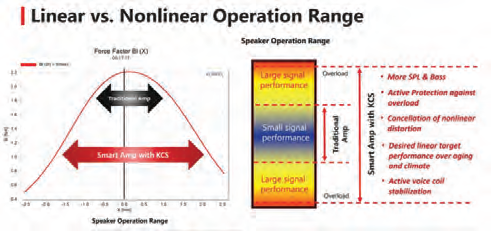
NAU83G60 is a stereo 2x30W amplifier with advanced audio DSP algorithm, low latency, non-linear applicable speaker control system and KCS (Klippel Controlled Sound) support. The KCS provides high accuracy mechanical and thermal speaker protection, while the non-linear control system reduces harmonic and inter-modulation distortion generated by speaker nonlinearities. With its active DC compensation, the audio coil can be operated in optimum listening position for maximum bass output. NAU83G60 voltage and current detection allows continuous identification of speaker parameters. Thus, the parameter changes caused by aging, production differences or climate changes can be compensated. While the conventional linear speaker protection algorithms fail at the most important point, namely at high amplitudes, the NAU83G60 with KCS stands out in this regard. The unique feature set allows the speakers to be operated safely at their physical limits. This provides higher sound and deeper bass, as well as better sound quality for optimum performance.
Specifications
- Stereo 30W Output Power (@4Ω Load, 10% THD+N, 24V)
- Mono 60W Output Power (@PBTL mode, 2Ω Load, 10%
THD+N, 24V) - 0.05% THD+N (@8Ω, 1W Output Power)
- Operating Voltage (5V to 24V)
- 2 x 15 band PEQs
- Crossover and audio mixer for Ultrasonic Bybass mode
- Sampling module
- Battery automatic level control and low voltage lock
- Battery limit inhibitor (UVLOP)
- High speed I²C (max. 1Mbps)
- I²S / PCM / TDM (can be increased up to 8 Channels; 192 kHz Sampling)
- Mechanical and thermal protection
- Stabilization, and speaker distortion compensation
- Applicable speaker alignment
- Output power and current limiter
- Optimal audio coil listening position
- Real-time speaker data reading
- Low latency active noise control
- Linearized echo blocking with reference signal
Areas of Application - Automotive / ANC – Computer
- TV / Sound Bar – Wireless / Active / Smart Speakers

Figure 5 shows a diagram of the amplifier protecting the speaker according to the amplitude of the signal. Figure 6 shows the operating range between linear and nonlinear amplifiers. As can be seen in the features and graphics, the new generation amplifiers such as the NAU83G60 can both offer better sound quality than conventional amplifiers and protect the system in which it is used against possible distortion risks. In this article, I have talked about the features of the new generation amplifiers, which are one of the “gifts” of developing technology.
Hoping to enjoy the happiness of being able to offer even better products by closely following the technology!
