FIELD APPLICATION DEPARTMENT CHIEF
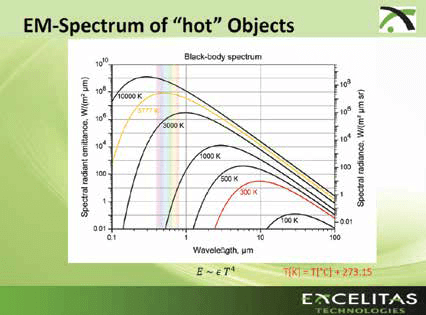
Excelitas, which Ozdisan Elektronik is a distributor of, is one of the companies that have proven itself globally with its success in optical detection systems. Optical detection has been utilized in motion, presence and temperature detection systems for many years. Among these, temperature sensing has become so important today that both the company that manufactures the sensor that will do this job and the customer who will utilize this sensor have big responsibilities. Recently, particularly following the coronavirus epidemic, from which the whole world is suffering and mandatory precautions have been taken, many companies that aim to measure people’s temperature by avoiding contact have been established. Unfortunately, in the method of non-contact temperature measurement, the accuracy of the sensor used alone is not enough. In addition, it is necessary to reach the result by taking into account the IR radiation, reflection measurement angles, measurement distance and multiple similar parameters. In this article, we will try to explain this measurement method systematically using the Excelitas CaliPile product. Excelitas manufactures several temperature sensors in the Thermopile category. The capabilities of these sensors differ according to each other. If we need to talk about the main categories;
• Analog Thermopile group,
• Digital Thermopile group,
• PreCalibrated Digital (CaliPile) Thermopile group,
Theoretically, all of these three groups function the same way. They measure the temperature of the surface they look at according to the relevant angle and provide related information, but actually this varies depending on the user’s expertise. For using the analog and uncalibrated digital sensors, it is necessary to have mastery of these issues on the sensor side in addition to knowing the radiation emitted from the human body and the physical rules behind this measurement method. For this purpose, Excelitas has launched the CaliPile series, which is a pre-calibrated series, in order to direct its users directly to the application without having to deal with the sensor. CaliPile series is offered in three different cases. One of them is in an SMD case, while the others are in a metal DIP case.
Analog Thermopile group,
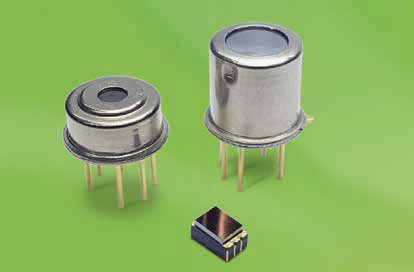
“MultiSensor development kit can be used for testing all of the Excelitas digital sensors.”
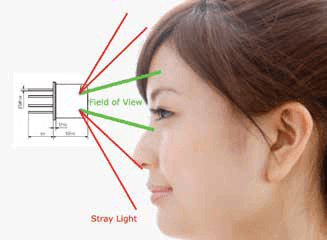
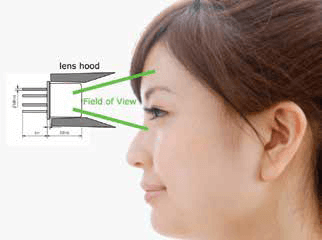
The main difference between them is the angle of view. The viewing angle is a parameter that varies completely according to the application. According to the viewing angles, the CaliPile series is defined as follows;
• TPIS 1S 1385/ 5029 (SMD) The viewing angle is 120 degrees
• TPIS 1T 1084/7502 (DIP) The viewing angle is 60 degrees
• TPIS 1T 1086 L5.5 (DIP) The viewing angle is 5 degrees
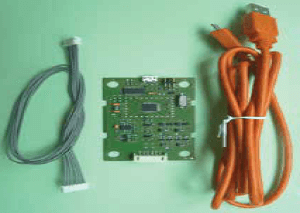
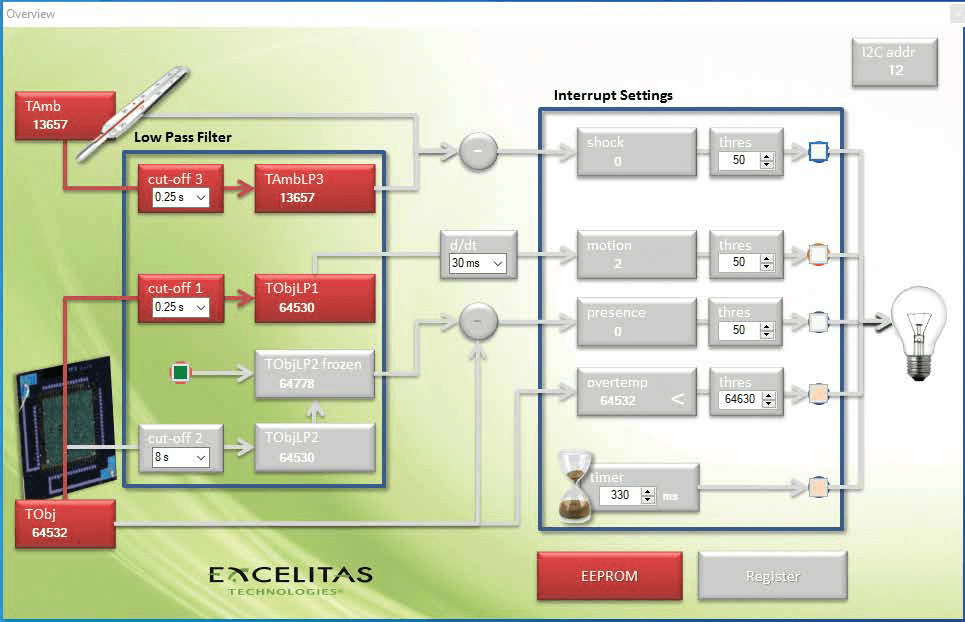
We can exemplify the selection criterion at this point as follows: In a project where the temperature of a room is to be measured, a wide viewing angle such as 120 degrees is selected as the sensor is required to see the entire room, whereas in a project where human temperature is to be measured, the narrowest angle would be appropriate as only the temperature of the desired area (forehead) is to be measured. Calipile sensors work with I2C communication, which is a very common communication protocol. The operation of the sensor can be ensured by adjusting the various filters in it to the appropriate settings. In order to test the sensor, Excelitas company offers both a development kit that these products can work with and a computer software to enhance the experience in all this chaos. The development kit, called MultiSensor, manufactured by Excelitas, can also be used to test all the digital sensors manufactured by Excelitas. Using this sensor kit, sensors can be tested without designing a PCB or writing a line of code, and it can be predicted whether they are suitable for use. It supports not only with demokit but also with a computer software that instantly displays all register values and provides visual testing opportunities.
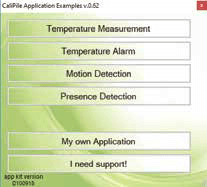
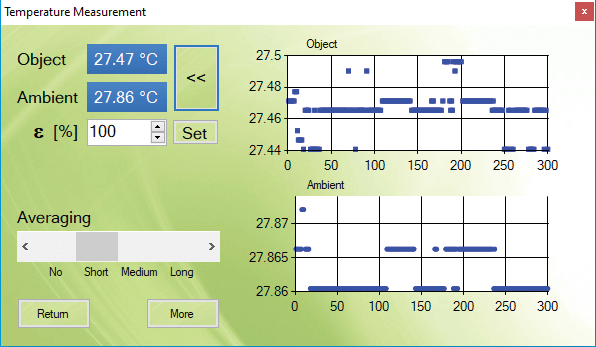
CaliPile series products can be used in 4 different modes. These are; temperature measurement, temperature alarm, motion detection and presence detection. For the temperature detection part, we see a system that shows the temperature of both the object it is looking at and its environment. Here, the value can be recorded both by selecting the speed of change or by manually entering the object’s temperature. While you can monitor the tabular change of incoming data, the frequency of change can also be controlled.
There is an interface where you can see everything, from the raw values of the incoming data to the related register values, in real time. Here you can observe how much the change is affected by playing with the filter values. The values obtained as a result of the tests are provided for convenience in the development stage, by using them as settings from the software. Thus, you can successfully complete the first of the two most important stages of the non-contact temperature measurement system, which is the “using the sensor”. The other important stage is the calibration stage of the sensor.

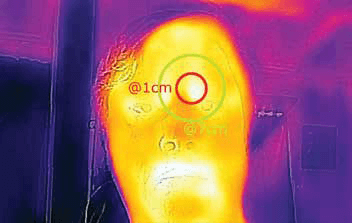
At the beginning of our article, we mentioned that the CaliPile family is offered with three different points of view. The 5-degree product presented here is an indispensable aspect for non-contact temperature measurement. The most important reason for this is that the product designed for non-contact temperature measurement is kept a certain distance away from the human body. Although this distance varies from person to person, it is not possible to measure it at the same distance all the time. Therefore, there are serious measurement differences between a product held 1cm away from the human body and a product held 15cm away. We know that the temperature sensor measures the area of a cone consisting of the viewing angle and the distance, as well as the air density entering this cone. We can give an example for this calculation in a more understandable way as follows;
1) When the sensor with 120 degree viewing angle is used
a. For a distance of 1cm;
The height of the cone is 1 cm, and when we take into account the peak angle of 120 degrees;
Cone base radius: 1.73cm
Cone base area: 9.42 cm²
Cone volume: 3.14 cm³
b. For a distance of 15cm;
The height of the cone is 15 cm, and when we take into account the peak angle of 120 degrees;
Cone base radius: 25.98 cm
Cone base area: 2120.45 cm²
Cone volume: 10602.25 cm³
2) When the sensor with 5 degree viewing angle is used
a. For a distance of 1cm;
The height of the cone is 1 cm, and when we take into account the peak angle of 5 degrees;
Cone base radius: 0.04 cm
Cone base area: 0.0054 cm²
Cone volume: 0.0018 cm³
b. For a distance of 15cm;
The height of the cone is 15 cm, and when we take into account the peak angle of 5 degrees;
Cone base radius: 0.65 cm
Cone base area: 1.3474 cm²
Cone volume: 6.7373 cm³
“The material temperature of the lens to be used should be the same as the sensor.”
As can be seen from the calculations, when we change the sensor viewing angle in conditions where the entire system is the same (software and hardware), uncontrollable magnitudes appear. For this reason, using a narrow-angle product in a non-contact temperature measurement project is becoming mandatory, rather than optional. We aim to minimize the distance between the measurement area, the measuring device and the object to be measured as much as possible. Although a narrow-angle sensor is used, it is still recommended to use a lens, since the sensor looks at the area to be measured at a fairly narrow angle, which will directly affect the measurement results. One of the considerations to be taken into account here is that the material temperature of the lens to be used should be the same as the sensor. Otherwise, the sensor will affect the temperature it will measure as it will see the lens. Unwanted light coming from outside will be filtered out after lens use. Thus, we will obtain an accurate measurement provided that the distance between the area where the temperature will be measured and the sensor is not changed. As can be seen from the calculation example above, measurement errors will occur due to the volume of the cone changing as the distance changes. To prevent this, a distance sensor can be added to the product. Temperature calibration can be made according to the distance information to be obtained from this distance sensor. Excelitas CaliPile sensors have a medical degree of accuracy, and when used correctly very sensitive products can be manufactured.