


Moore’s Law, suggested by Gordon E. Moore in 1965, is a principle that offers insight into the development dynamics of the microprocessor industry. In his article titled “Cramming More Components onto Integrated Circuits”, Moore stated that the number of transistors used in integrated circuits (IC) will double approximately every two years, and in parallel to this, the processing capacity will increase. This suggestion by Moore has become a principle describing technological progress in the semiconductor industry and has preserved its validity for many years.
The Basic Conceptual Framework of Moore’s Law
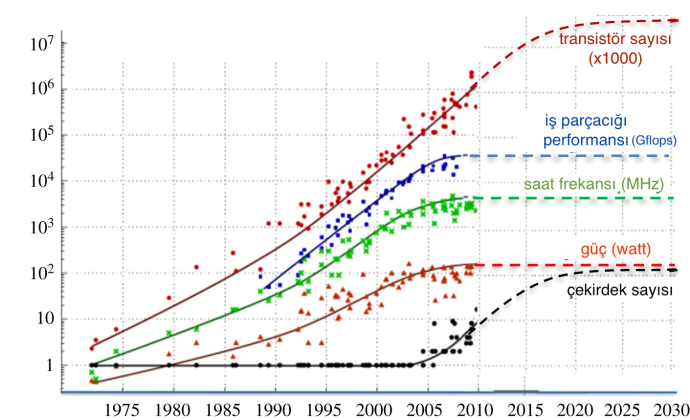
- Increase in Transistor Density: It is estimated that the number of transistors used in microprocessors will double every two years. This increase will allow the size of integrated circuits to be reduced, and more processors can be placed in the same space.
- Cost Reduction and Performance Increase: This increase in transistor density also increases the processing power of computers, while also reducing the costs. This insight leads to a consistent reduction of computing costs and continuous improvement of microprocessors.
Technological and Economic Reflections of Moore’s Law
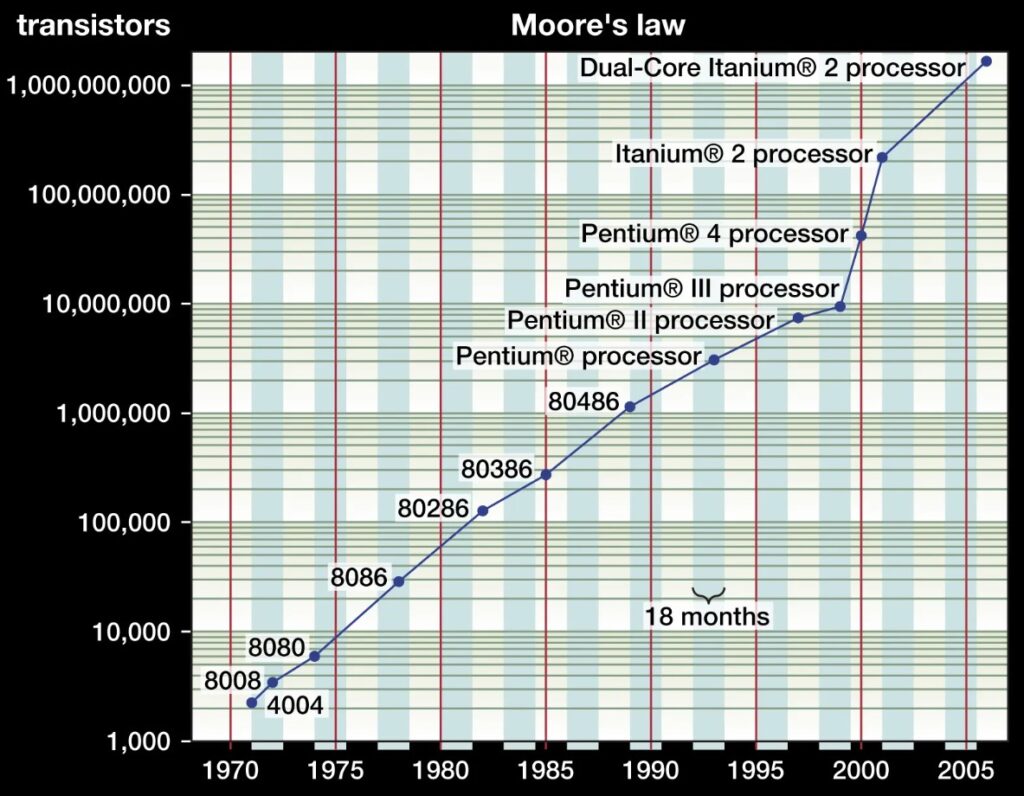
Its Role in the Semiconductor Industry:
Moore’s Law has been recognized as a kind of guide for the microprocessor industry and become a benchmark that determines the development dynamics for the said industry. Semiconductor companies have shaped their chip development processes and R&D investments in accordance with this law. The constant increase in processing power has played a central role in the evolution of many technologies, from personal computers to smartphones, or servers to artificial intelligence systems.
Economic Growth and its Impact on Digitalization:
Moore’s Law has also had a profound impact on the global economy. High-performance computers, low-cost electronic devices and increased data processing capacity have accelerated digitalization in a wide range of fields, from industrial production processes to financial services, or education to the healthcare sector. As a result, while the computing capacity has increased, the reduction of costs has triggered new business models and waves of innovation.
Directing the Pace of Technological Progress:
The development process envisaged by Moore’s Law has enabled information technologies to progress rapidly. In particular, the constant increase in microprocessor performance has led to the introduction of technologies that are renewed every two years and has directed the competition strategies of technology companies. In this context, Moore’s Law has been a catalyst that has guided the rapidly advancing nature of technology.
The Limits and Future of Moore’s Law

As the transistor sizes have been reduced every two years, the validity of Moore’s Law has been maintained for many years as well. However, some physical limitations have caused several question marks about the validity of the predictions of this law. Although modern semiconductor technology has succeeded in reducing transistor sizes to nanometer scales, the materials in atomic level have faced some physical limits. Issues such as electron leakage, thermal effects and quantum tunneling have made it difficult to shrink the transistors further.
However, the momentum provided by Moore’s Law continues to be in effect in different areas of innovation.

- 3D Chip Designs (3D IC): With their layered chip architectures, they go beyond 2D integrated circuit designs and provide further performance improvement.
- Quantum Computers: It is a new computing paradigm that aims to exceed the limits of Moore’s Law. Quantum computing promises a radical increase in speed and capacity compared to conventional transistor-based processors.
- New Materials: Several researches carried out on alternative materials (such as graphene) that can replace silicon have indicated a potential to further increase the momentum of Moore’s Law.
The Importance of Moore’s Law
The Moore’s Law has played a major role as a “central conceptual framework” in the development of computing technologies, accelerated technological progress in the microprocessor industry and triggered large-scale digitalization processes. However, considering the physical limitations and technology dynamics, it is obvious that the estimations related to the Law have a limited validity, and alternative ways of innovation will be available in the future. The Moore’s Law is recognized as a symbol that determines the pace of technological progress, rather than an individual engineering law by itself.
