


Technology is used to help resolve game-related disputes or ensure the protection of the game rules, helping referees and match officials to make quick and correct decisions. Events such as the “Hand of God” goal scored by Maradona have now become unrepeatable, while opportunities won on the offside line rarely go down in history now. However, this new era, which has entered the football world like a technological storm, gives us a sound reason to believe that a new revolution in football is knocking at the door.

So, how correct are the VAR results? How does this assistance system provide referees with correct and reliable data and video images from multiple angles in such a short period of time?
The Relentless “VAR”
The Video Assistant Referee (VAR) technology was first introduced in Russia at the 2018 World Cup, but truly played a major role at the 2022 World Cup in Qatar. The VAR system allows referees to detect violations and assess the exact positions and movements of players on the pitch with extremely high accuracy.

When the 2022 World Cup opened, Ecuador scored the first goal with a penalty kick against the home side Qatar. This penalty was awarded using VAR technology for the first time in the history of the World Cup.

The Basic Technology Used in VAR Systems
The ability of a VAR system to make quick decisions relies on 12 tracking cameras located on the pitch and a chip embedded in the ball. This chip contains two independent sensors that work simultaneously: an ultra-wideband sensor (UWB) and an inertial measurement unit (IMU).
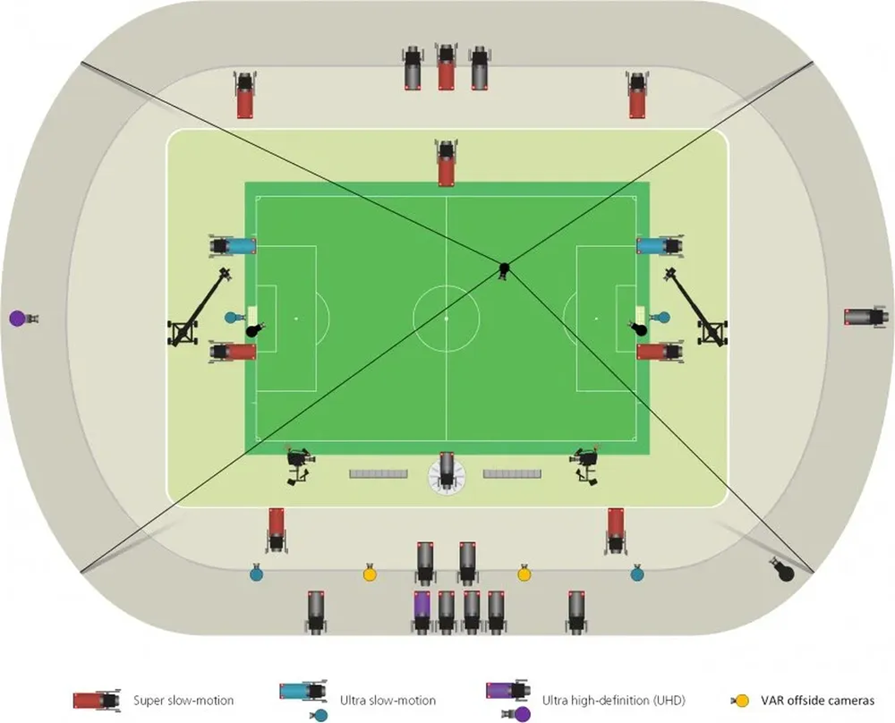
The UWB receives precise location data and transmits it to the base station, while the IMU detects data about the speed, direction and acceleration of the ball. This data is transmitted to the video operation room 500 times per second.

The VAR technology system is, in general, a full-process IoT (Internet of Things) solution. From the collection of front-end data to the communication with the UWB base station and back-end data analysis, it effectively integrates motion sensors, locations, communication and edge computing. These are the basic functions of IoT. Although the interaction of two sets of sensors guarantees the sensitivity of data collection, there is a delay in data transmission. Real-time analysis of football data requires edge computing to process them. When a UWB base station receives football data, the edge computing processors located near the pitch perform coordinated operations to identify the movements of players using 12 tracking cameras, calculating the speed, movement and distance almost simultaneously.

Edge Computing Is Becoming Widespread
Apart from the football pitch, the edge computing is increasingly taking its place in more and more areas of people’s lives, such as smart furniture, industrial control and autonomous vehicles, and is playing an important role in these areas.
As new applications develop, the demands on the internal storage space of the carrier equipment and the tasks it undertakes are becoming more intensified. From saving the operating system to data buffering, or temporary storage of images and videos to partial network buffering calculations, all the functions are becoming increasingly complex and require more storage space with much faster reading speed.
In this Artificial Intelligence of Objects (IoT) era, many operational tasks are now being directed to edge terminals. These tasks require artificial intelligence and machine learning models with large data storage space for keywords and images recognition, as well as for internal memory. As mentioned above, the existing application scenarios have relatively high demands in terms of time delays and data’s passing through edge computing processors. Therefore, internal storage has become a decisive factor in advanced computing.
Internal Storage Required for Edge Computing
Taşıyıcı ekipmanlar için, hassas veri toplama, enerji verimliliği ve maksimum pil ömrü gerektiren farklı uygulama senaryolarını sorunsuz bir As for carrier equipment, it is estimated that the devices that can seamlessly carry out different application scenarios that require sensitive data collection, energy efficiency and maximum battery life will come into play.
HYPERRAM is an excellent choice for smart-band applications. For applications with TWS headphones and size demands with higher power consumption, HYPERRAM offers the following advantages:
- Ultra-low power consumption: HYPERRAM offers ultra-low power consumption for operations and hybrid sleep modes. Operating at room temperature with 1.8V, the 64Mb HYPERRAM consumes 70µW of power in standby mode, while the hybrid version consumes only 35µW of power in sleep mode.
- Simplified design: Compared with pSRAM equipped with 31 signal pins, the HYPERRAM has only 13 signal pins, which significantly simplifies the design and manufacturing processes.
- Compact: The packages provide fewer pins and interfaces for the main controller, reducing the space of the board.
DRAM is a more suitable product for applications that require higher real-time data transmission capabilities, storage capacity, data bandwidth and stability. For instance, each millisecond of delay when driving a vehicle can have serious consequences. The memory must have sufficient data bandwidth and storage capacity to support real-time data transmission and processing.
Winbond offers a range of DRAM products such as LPDDR, LPDDR2, LPDDR3 and LPDDR4, which are suitable for applications sensitive to low-power consumption. Recently, Winbond introduced the LPDDR4/4X model with a capacity of 2 to 4Gb. The latest LPDDR4/4X model offers the following advantages:
- It adopts a compact 100BGA package with a size of only 7.5×10 mm².
- It complies with the JEDEC JED209-4 standard to help reduce carbon emissions.
- It has the capacity to transmit data at 4267Mbps, which is of great importance particularly for consumer applications.
- It is suitable for applications that achieve high data transfer rates with small packages.
How these small sensors are changing the fairness and accuracy of football is directly attributed to the chips that support the underlying technology. As the Internet of Things leads us to a more connected world, the success of edge computing will increasingly depend on the internal memory.
